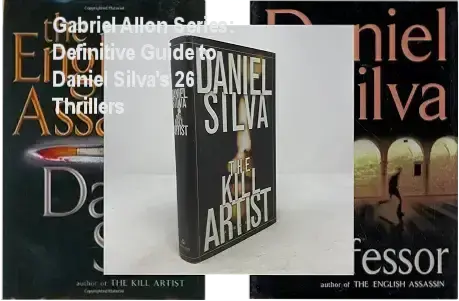
Gabriel Allon Series: Definitive Guide to Daniel Silva’s 26 Thrillers
Committing to a twenty-six-book series is not a reading decision; it is a lifestyle commitment. Most thriller fans hesitate at the three-book mark, worried about diminishing returns or a protagonist who overstays his welcome. Daniel Silva’s Gabriel Allon saga defies that entropy by anchoring its espionage in something rare: consequence. The art restoration cover isn’t just flavor text; it dictates the pacing, forcing a stillness that makes the violence sharper. You can check the current availability of the complete hardcover collection here.
The market is flooded with operators who drink too much and feel too little. Allon restores Caravaggios and Poussins. That duality—brushstrokes versus bullet wounds—creates a unique texture across decades of publication. It allows Silva to explore geopolitics without sacrificing the intimate character study that keeps readers buying hardcovers year after year. The series evolves from pure assassination plots into complex statecraft, mirroring the actual shift in intelligence work from Cold War binaries to the messy asymmetrical conflicts of today.
Ready to dive into “Gabriel Allon (26 book series)”?
Explore available editions, check current live pricing, or download a free sample directly on Amazon.
Preview Free Sample & Check Price on Amazon
*You will be redirected to Amazon. As an Amazon Associate, we may earn from qualifying purchases.
Writing Style: The Restorer’s Precision
Silva writes with the restraint of his protagonist. There is no purple prose here. Sentences are functional, built to carry the weight of tradecraft terminology without clunking. He respects the reader’s intelligence, refusing to over-explain the mechanics of a dead drop or the politics of the Vatican banking system. This trust creates velocity. You move fast because the author assumes you can keep up.
Dialogue is a standout feature. It crackles with subtext. Allon rarely monologues; he parries. His conversations with Shamron, the spymaster, are chess matches disguised as arguments. On Reddit’s r/thrillerbooks, a common sentiment is that the “talking scenes” are often more tense than the shootouts. That is a testament to Silva’s ear for bureaucratic friction. The banter with Christopher Keller, the SAS operator turned assassin, provides necessary levity without breaking the operational tone.
Pacing follows a distinct rhythm: slow burn investigation, sudden explosive violence, quiet aftermath in a workshop. This mirrors the restoration process itself. Strip the varnish, repair the canvas, reapply the finish. Readers on Goodreads frequently note that the first 100 pages of a new entry can feel “slow,” but they almost universally admit the payoff justifies the patience. The series rewards the long view.
Narrative Arc: From Vendetta to Statecraft
The Kill Artist opens with a personal tragedy. It is a revenge story. By book ten (The Moscow Rules), the scope has widened to Russian nuclear material. By book twenty (The Order), Allon is navigating a papal conclave to prevent a geopolitical crisis. This progression feels earned. Allon ages. He promotes. He accumulates scars, both physical and psychological. He becomes the very institution he once chafed against.
This long-form character development is the series’ “killer app.” In a genre dominated by static icons (Bond, Reacher, Ryan), Allon changes. He marries, fathers children, loses friends, and wrestles with the morality of targeted killing. A verified Amazon reviewer summarized it perfectly: “You aren’t just reading a plot; you’re watching a life.” The hardcover format amplifies this. Holding the physical weight of the later volumes feels like holding the weight of his history.
However, the entry barrier is real. Starting at Book 1 is mandatory. Silva does not write “previously on” summaries. He writes continuity. Missing the setup for the Tariq arc or the Sarah Bancroft dynamic renders later emotional beats hollow. This is a feature, not a bug, but it demands commitment.
Core Themes: Memory, Identity, and the Cost of Silence
The art restoration metaphor runs deep. Allon repairs damaged beauty. Intelligence work destroys it. The tension between creation and destruction is the engine of every novel. Silva, a former journalist, treats the “Office” (Israeli intelligence) not as a superhero HQ but as a bureaucracy with rivalries, budget fights, and moral compromises.
Antisemitism and the Holocaust are not background radiation; they are active plot drivers. Silva refuses to let history settle. In The Rembrandt Affair and The Collector, stolen art serves as a conduit for exploring restitution and national identity. This grounds the spycraft in a specific, painful reality that generic thrillers avoid. Discussions on r/books often highlight this as the differentiator: “Silva writes about Jews who refuse to be victims again, but shows the soul-crushing cost of that refusal.”
The “Office” politics mirror real-world Mossad dynamics—compartmentalization, the “sayanim” network, the friction between Caesarea (ops) and Research (intel). It adds a layer of verisimilitude that satisfies the “competence porn” itch without glorifying the violence. The kills are messy. The collateral damage is counted.
| Series Phase | Books (Approx.) | Who Is This Actually For? This isn’t your typical “shoot-em-up” airport novel. Daniel Silva writes for the reader who enjoys the geopolitical chess match more than the actual checkmate. The ideal reader is someone who appreciates the intersection of high art and low-level espionage. If you enjoy the slow-burn tension of John le Carré but want a protagonist with more lethal capabilities, Gabriel Allon fits the bill. It appeals specifically to those who:
Who Should Skip This Book?Avoid this series if you are looking for a quick, mindless adrenaline rush. If you find detailed descriptions of art restoration tedious or if you prefer your thrillers devoid of political nuance, this will feel like a slog. Common purchasing misstep: Buying the entire series expecting a fast-paced action franchise. While the stakes are high, the pace is deliberate. It is a narrative marathon, not a sprint. Value Analysis: Is It Worth the Investment?From a value perspective, the Hardcover edition is a prestige choice for collectors. However, the real “cost” here is time. With 26 books in the series, entering the Gabriel Allon universe is a massive commitment. The writing is elegant and the research is impeccable. You aren’t just paying for a story; you’re paying for a meticulously crafted simulation of international intrigue. The “value” lies in the consistency of the character development over decades of publishing. Editorial VerdictThe series succeeds because it treats the reader as an adult. It doesn’t over-explain the politics, nor does it rely on clichés. Gabriel Allon is a compelling anchor—a man torn between the silence of the art studio and the noise of the battlefield. While the formula can become predictable after a dozen entries, the first few novels, particularly The Kill Artist, remain gold standards of the genre. To see how current readers are ranking the evolution of the series, you can check the latest user reviews and edition pricing. Final Editorial Verdict“Gabriel Allon (26 book series)” delivers on its core promise for its intended audience, offering compelling insights without fluff. As highlighted in our detailed edition breakdown, its practical depth and readability are its greatest strengths. We also recommend checking the official Kindle sample and reader ratings before making your final purchase decision. *You will be redirected to Amazon. As an Amazon Associate, we earn from qualifying purchases. Posts Similares
|
|---|