Most of us treat our bodies like a rented car we never received the manual for. We guess at the fuel, ignore the warning lights, and wonder why the engine stalls during a mid-afternoon slump or a sleepless night.
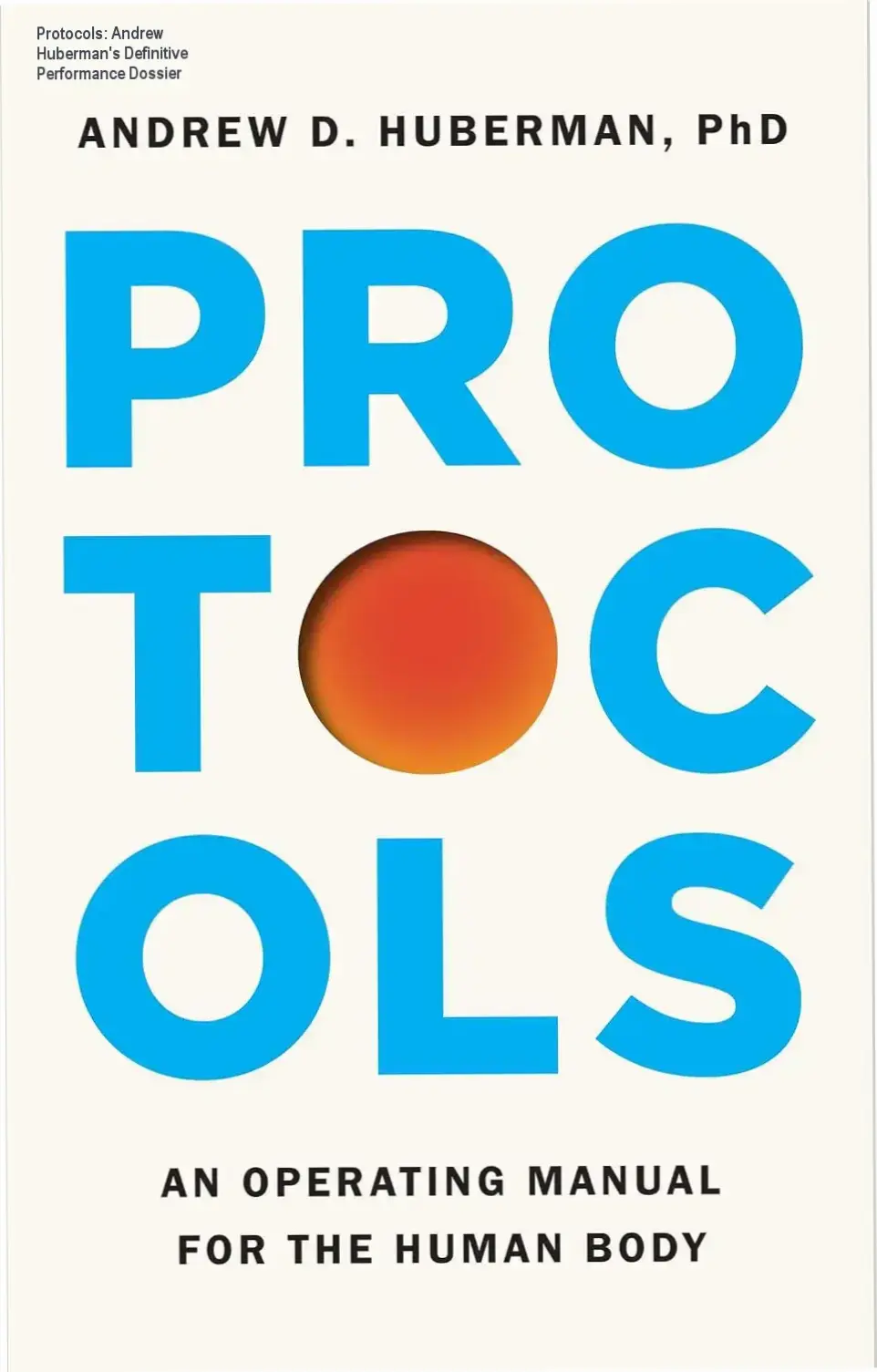
The “biohacking” world is currently a chaotic mess of conflicting advice. One guru suggests fasting for twenty hours; another insists on eating every three. In this noise, Andrew Huberman has emerged as the signal. His work, specifically Protocols: An Operating Manual for the Human Body, promises to move beyond anecdotal “hacks” and provide a structured, science-backed framework for human optimization.
The expectation is immense. Huberman Lab is already a global phenomenon. Readers aren’t looking for another motivational speech or a vague wellness guide; they want a technical blueprint. They want to know exactly how sunlight affects cortisol and how a specific breathing pattern can neutralize stress in sixty seconds.
Ready to dive into “Protocols: An Operating Manual for the Human Body”?
Explore available editions, check current live pricing, or download a free sample directly on Amazon.
*You will be redirected to Amazon. As an Amazon Associate, we may earn from qualifying purchases.
The Architecture of a Biological Manual
Huberman doesn’t write like a novelist; he writes like a neuroscientist who knows you’re impatient. The book is structured not as a narrative, but as a system of operations.
The core thesis is split into two distinct layers. First, the foundational behaviors. These are the non-negotiables—the baseline habits that keep your biology from crashing.
Second, he introduces specific tools. These are the “surgical” interventions. Need to focus for four hours straight? There is a protocol for that. Need to drop your heart rate during a panic attack? There is a tool for that too.
This binary approach is what separates this book from generic health guides. It acknowledges that while a good sleep schedule is the foundation, life happens, and you need acute tools to handle the chaos.
Decoding the Seven Pillars of Performance
The book organizes the human experience into seven critical domains. It is an ambitious attempt to codify everything from the moment you wake up to the moment you hit the pillow.
The “Light” protocol is perhaps the most famous. Huberman emphasizes viewing sunlight within the first hour of waking to set the circadian clock. It sounds simple, but the biological ripple effect on mood and sleep is profound.
Then there is the “Stress Control” section. Instead of telling you to “just relax,” he provides mechanical breathing patterns. He treats the nervous system like a dimmer switch that you can actually control.
Below is a breakdown of how these pillars are integrated into the “Manual” approach:
Pillar
Primary Goal
Example Protocol
Sleep
Cognitive Recovery
Temperature regulation & light blocking
Who Should Actually Buy This Book?
This isn’t a casual read for the “wellness-curious.” Protocols is designed for the optimization obsessive.
The ideal reader is someone who views their body as a system to be engineered. If you are a high-performer, an athlete, or a professional dealing with chronic cognitive fatigue and you actually enjoy the “why” behind the “how,” this is your manual.
It appeals to those who find typical health books too fluffy. Huberman doesn’t deal in “vibes”; he deals in dopamine baselines, circadian rhythms, and neural plasticity.
Who Should Skip It?
If you are looking for a “10-minute morning routine” or a simplified cheat sheet, skip this book.
At 688 pages, this is a dense technical tome. If the idea of reading about the biological mechanisms of light exposure before you actually go outside sounds tedious, you will likely find this book overwhelming.
Avoid this if you prefer intuitive, holistic health approaches over rigid, science-backed protocols. This is an operating manual, not a motivational diary.
Value for Money: Investment vs. Effort
From a pure “information per dollar” perspective, the value is immense. You are essentially getting a curated distillation of decades of Stanford-level neuroscience and world-class expert interviews.
However, the “cost” isn’t just the price tag—it’s the cognitive load. Many buyers make the mistake of expecting a quick-start guide. Instead, they get a comprehensive textbook on human physiology.
The real value lies in the customization. Huberman doesn’t just give you a rule; he gives you the levers to adjust that rule based on your specific biology.
Editorial Verdict
Protocols succeeds because it bridges the gap between academic research and actionable habit. It strips away the mystery of “feeling better” and replaces it with a set of biological switches.
The risk is “analysis paralysis.” With so many protocols across seven different areas of life, the challenge isn’t finding the information—it’s the discipline to implement it without burning out.
“Protocols: An Operating Manual for the Human Body” delivers on its core promise for its intended audience, offering compelling insights without fluff. As highlighted in our detailed edition breakdown, its practical depth and readability are its greatest strengths.
Summer reading lists are usually cluttered with doorstoppers that demand weeks of commitment, but sometimes the real challenge is finding a complete emotional arc you can finish before your sunscreen wears off. The novella format walks a razor-thin line: too short and the romance feels unearned; too long and it loses that “single sitting” appeal….
The nightmare of digital erasure isn’t science fiction anymore; it’s a Tuesday morning headache waiting to happen. We trust systems—banks, governments, cloud backups—to validate our existence. Peter James takes that trust and shreds it in John Grebble Is Gone. The premise is brutally simple: a man wakes up to find every database, every institution, and…
What do you do when the world ends not with a bang, but with a bizarre reality TV show? That’s the existential and absurdist premise of *Dungeon Crawler Carl* by Matt Dinniman—a novel that plunges readers into a post-apocalyptic arena where survival hinges on wit, luck, and the unshakable bond between a disillusioned Coast Guard…
Navigating the intersection of high-stakes politics and personal trauma is a recurring theme in contemporary suspense fiction. Readers often seek stories that balance global conspiracies with the intimate, messy realities of family survival. In State of Unrest, Marie Force explores whether a person can truly protect their loved ones when the very institutions designed for…
We need to produce the first part of a professional analytical book review. Must start with contextualization paragraph, between 180 and 320 words. Must include exactly 1 contextual affiliate link using tag “Link_afiliado”. Probably the link should be inserted as Link_afiliado? They said “using the tag ‘Link_afiliado’ (e.g., inviting the reader to check the book’s…
We need to produce the first part of a professional analytical book review following strict instructions. We must start with a contextualization paragraph ( ) of between 180 and 320 words. Must include exactly 1 contextual affiliate link using the tag “Link_afiliado”. Must not start with heading. Must vary opening using practical situation, common reader…