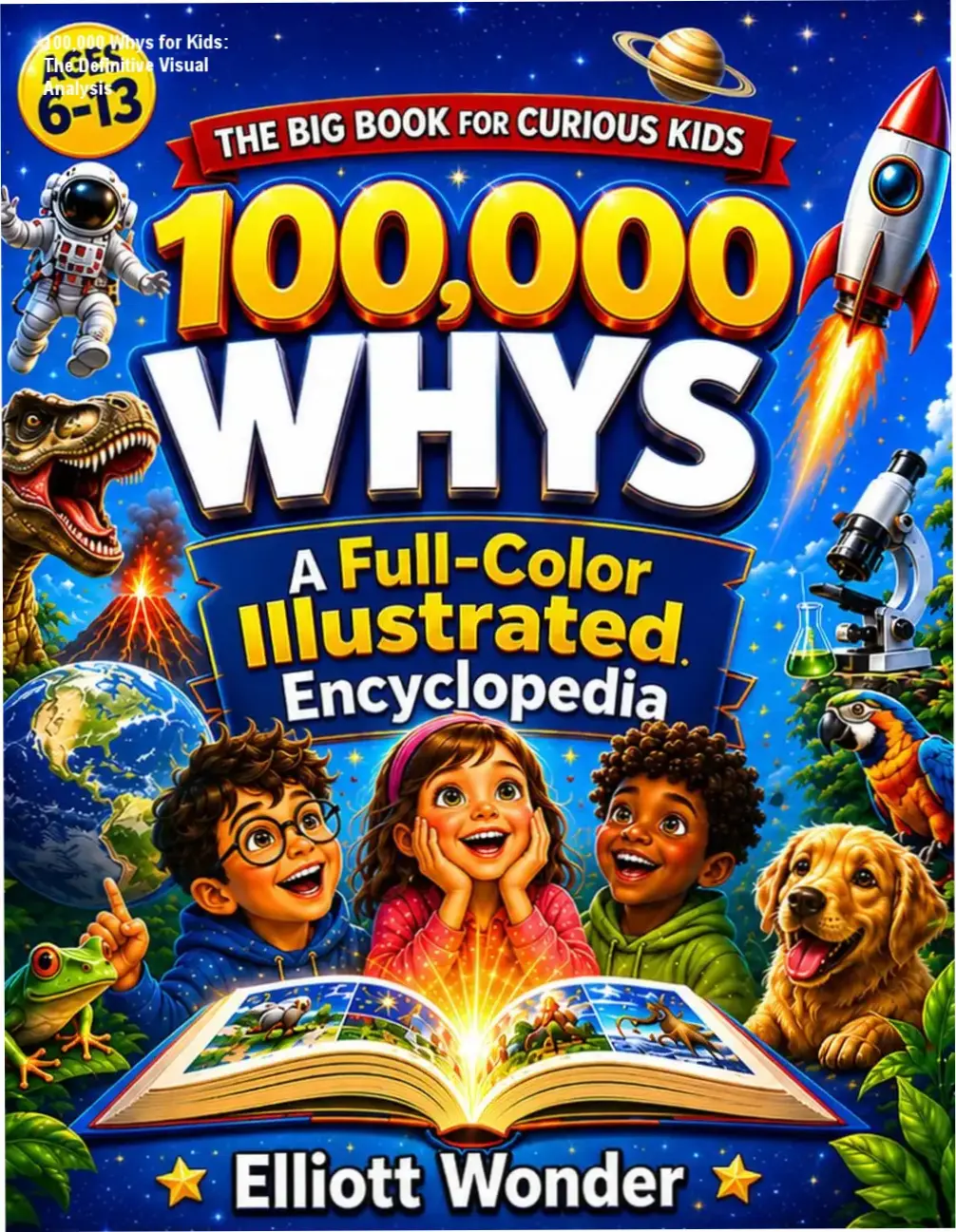
100,000 Whys for Kids: The Definitive Visual Analysis
Every parent knows the “Why” phase. It starts with innocent curiosity about the sky and quickly evolves into a relentless interrogation of how everything in the universe functions. Most educational books for children fail this phase because they are either too dry, resembling a textbook, or too superficial, offering one-sentence answers that leave a curious child unsatisfied.
The challenge isn’t finding information; it’s finding information that matches a child’s cognitive pace. We live in an era of short-form content, yet many encyclopedias still rely on dense blocks of text that kill a child’s interest before they reach the second paragraph. This is where 100,000 Whys for Kids attempts to bridge the gap between raw curiosity and academic boredom.
When analyzing this product, the first thing a skeptical reviewer notices is the tension between the ambitious title and the actual page count. It promises a mountain of knowledge but delivers a curated experience. The real question is whether the visual delivery compensates for the numerical hyperbole of the title, and if it actually manages to keep a 12-year-old engaged while remaining accessible to a 6-year-old.
Ready to dive into “100,000 Whys for Kids”?
Explore available editions, check current live pricing, or download a free sample directly on Amazon.
Preview Free Sample & Check Price on Amazon
*You will be redirected to Amazon. As an Amazon Associate, we may earn from qualifying purchases.
The Marketing Paradox: 100,000 vs. 100
Let’s address the elephant in the room. The title claims “100,000 Whys,” but the technical specifications reveal 100 kid-friendly questions across 120 pages. From a journalistic perspective, this is an aggressive marketing stretch. You aren’t getting a hundred thousand answers; you’re getting a high-quality sample of the most common ones.
However, as a CRO analyst, I see why this works. Parents aren’t looking for an exhaustive database—they are looking for a tool that stops the constant questioning by providing a satisfying answer. The value isn’t in the quantity, but in the visual delivery.
By focusing on 100 core questions, Elliott Wonder avoids the “encyclopedia fatigue” where a child gets overwhelmed by too much data. The book functions more like a “Greatest Hits” of curiosity than a complete archive. If you are looking for a literal 100,000 answers, you’ll be disappointed. If you want a book that a child will actually open and read, this is a strategic choice.
Visual Architecture and Cognitive Load
The brilliance of this book lies in its layout. Most children’s books make the mistake of putting a small image next to a large wall of text. This book flips the script. Every page is built around a single “Why” question, treated as a visual infographic.
This approach drastically reduces the cognitive load. Instead of reading a three-page chapter on volcanology, the child sees a cross-section of a volcano, a clear explanation of magma, and a “Quick Fact” sidebar. It mimics the way children consume information in the digital age—fast, visual, and modular.
The inclusion of “common myths” is a critical touch. It doesn’t just teach what is true; it teaches how to identify what is false. This develops critical thinking skills rather than just rote memorization, which is the primary failure of traditional educational books.
| Feature | Traditional Encyclopedia | 100,000 WhysWho This Book Is Actually ForThis isn’t a traditional textbook; it’s a curiosity catalyst. The ideal reader is the “Why?” phase child—those between 6 and 13 who are bored by dry lists of dates but fascinated by why flamingos are pink or how computers “think” in binary. It is specifically engineered for visual learners. If your child struggles with dense blocks of text, the infographic approach here is a game-changer. It transforms the act of reading into a browsing experience, which significantly lowers the barrier to entry for reluctant readers. Who Should Skip This BookAvoid this if you are looking for an exhaustive academic reference. Despite the hyperbolic title suggesting “100,000 Whys,” the book focuses on a curated set of high-impact questions. If you expect a comprehensive encyclopedia that covers every niche scientific detail in existence, you will be disappointed. Similarly, if your child has already progressed to advanced scientific studies or prefers deep-dive narratives over “at-a-glance” summaries, the simplified nature of these answers might feel too basic. Value for Money & Reality CheckAt 120 pages, you aren’t paying for sheer volume; you’re paying for curation and graphic design. The real value lies in the visual translation of complex concepts. While many “fact books” are simply lists of trivia, this one attempts to explain the mechanism behind the fact. The most common purchasing misstep is taking the title literally. You aren’t getting 100,000 individual entries. You are getting a structured visual journey. When viewed as a “starter kit” for curiosity rather than a complete scientific library, the value proposition is strong. Ultimately, this is a tool for connection. It is less about the child reading it in isolation and more about the conversations it sparks between parent and child. It is a screen-free win that rewards curiosity without overwhelming the reader. To see how other parents are using this to bridge the gap between curiosity and learning, you can check the latest verified user reviews on Amazon. Final Editorial Verdict“100,000 Whys for Kids” delivers on its core promise for its intended audience, offering compelling insights without fluff. As highlighted in our detailed edition breakdown, its practical depth and readability are its greatest strengths. We also recommend checking the official Kindle sample and reader ratings before making your final purchase decision. Relacionado Posts Similares
|
|---|