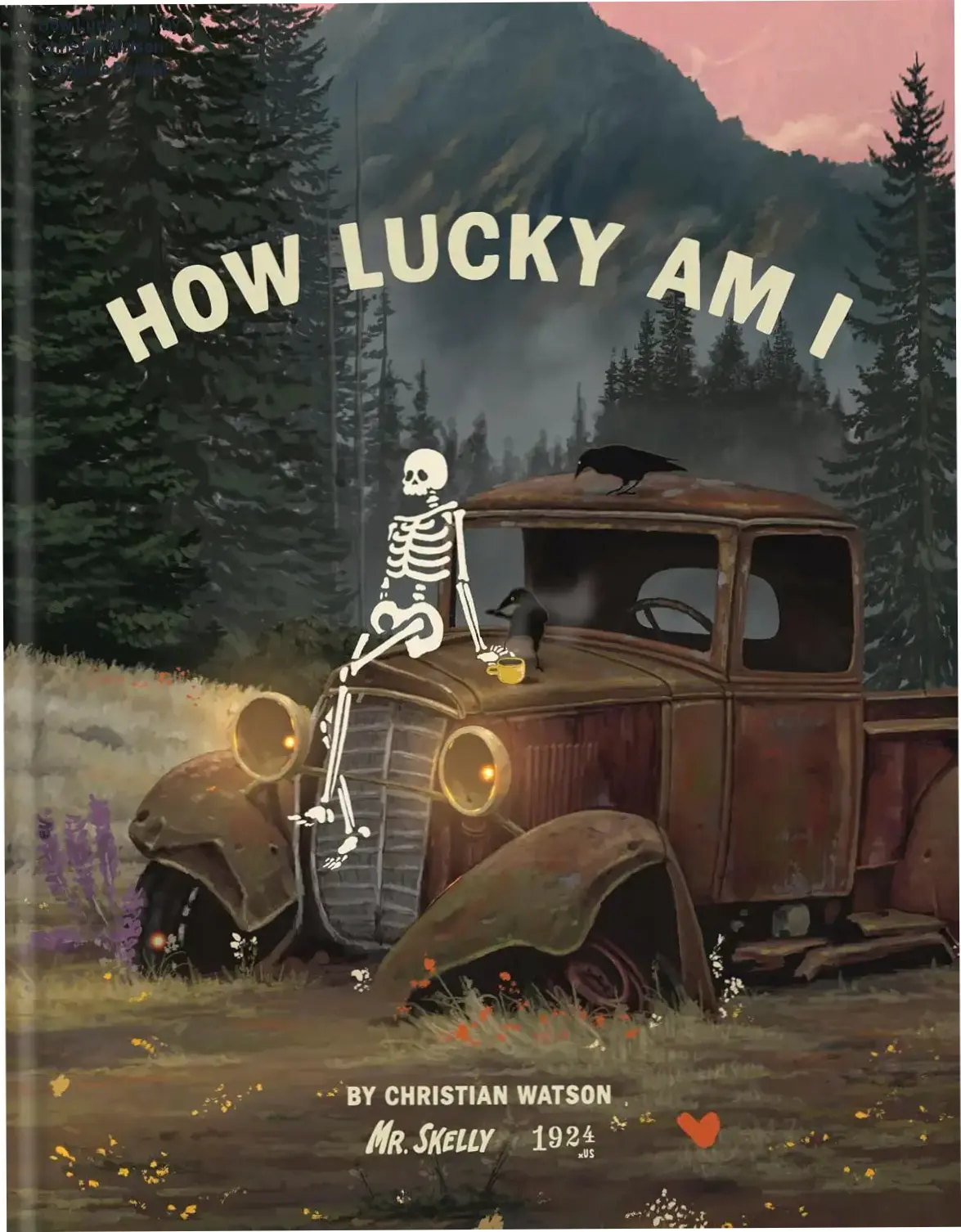
How Lucky Am I by Christian Watson: Complete Dossier
Most of us spend our lives chasing a version of happiness that feels like a moving target. We treat grief as a bug in the system and loss as a failure, ignoring the fact that these are the only things that actually make us human.
When you’re drowning in the noise of digital perfection, you don’t need another 400-page self-help manual. You need a mirror that doesn’t judge. That is where How Lucky Am I fits into the current cultural landscape, utilizing the simplicity of art to tackle the heaviest parts of existence.
Ready to dive into “How Lucky Am I”?
Explore available editions, check current live pricing, or download a free sample directly on Amazon.
Preview Free Sample & Check Price on Amazon
*You will be redirected to Amazon. As an Amazon Associate, we may earn from qualifying purchases.
The Visual Architecture of Grief
Christian Watson doesn’t write a traditional narrative. Instead, he uses Mr Skelly—a gentle, wandering skeleton—as a proxy for the reader. It is a clever psychological trick.
By stripping the character of skin and ego, Watson removes the barriers of identity. Mr Skelly isn’t a specific person; he is the essence of vulnerability.
The hand-painted imagery isn’t just “cute.” It serves as a pacing mechanism. The lush landscapes contrast with the stark reality of a skeleton, creating a visual tension that mirrors the experience of finding beauty in the middle of a breakdown.
The Paradox of “Deserving” Loss
The core of the book hinges on a provocative premise: “How lucky am I, to have lost what I wanted, to find what I deserved.”
To a skeptic, this sounds like toxic positivity. However, the analysis reveals something deeper. Watson isn’t arguing that loss is “good,” but that it is necessary for realignment.
“In the end, we’re all made of the same bones.”
This line anchors the book’s philosophy. It strips away social status, wealth, and failure, returning the reader to a baseline of shared human fragility.
The narrative structure doesn’t follow a linear plot. It follows an emotional arc. You move through joy, grief, and love not as chapters, but as atmospheric shifts.
Technical Breakdown: Effort vs. Reward
At 128 pages, the “reading” experience is fast. But the “processing” experience is slow. This is a book designed for the “slow living” movement, not for speed-readers.
| Feature | Analytical Insight | Value Score |
|---|---|---|
| Length | 128 pages (High density of meaning per page) | High |
| Format | Hardcover / Visual Essay | Premium |
| Tone | Poignant, minimalist, affirming | Balanced |
| Pacing | Non-linear; meditative | Subjective |
Expectation vs. Reality: Is it just “Instagram Art”?
Given Watson’s social media success, there is a risk that this book is merely a printed version of a feed. Many critics on Goodreads have questioned if the depth matches the aesthetic.
The reality is that the physical book adds a layer of intimacy that a screen cannot. The tactile nature of the hardcover and the layout of the hand-painted art force a slower consumption rate.
It isn’t a philosophical treatise. It won’t give you a 10-step plan to fix your life. If you are looking for a “how-to” guide, you will be disappointed.
However, if you are looking for a “how-to-feel” guide, it succeeds. It validates the messy parts of existence without trying to “solve” them.
Who This Actually Works For
This book is not for everyone. If you prefer rigorous logic or dense prose, this will feel lightweight.
It is specifically engineered for the “emotionally exhausted.” Those who are tired of the noise and need a quiet space to acknowledge their own pain.
- The Grieving: Provides a non-threatening way to process loss.
- The Overwhelmed: Offers a mental reset
Who This Book Is Actually For
How Lucky Am I isn’t a traditional narrative or a self-help manual. It is a visual meditation. If you are the type of reader who finds solace in minimalism and atmospheric art, this is your territory.
The ideal reader is someone currently navigating a “transition” phase—whether that is grief, a career pivot, or a general existential crisis. It appeals specifically to those who enjoyed the gentle, philosophical pacing of The Boy, the Mole, the Fox and the Horse.
Who Should Skip This Book
Avoid this purchase if you are looking for a structured, step-by-step guide to overcoming depression or a complex, plot-driven story. If you find “whimsical” imagery or sentimental reflections too abstract or “fluffy,” you will likely find the 128 pages lacking in substance.
This is not a textbook on resilience; it is a mirror for your own emotions. If you require clinical frameworks or dense academic prose to feel a sense of progress, this will feel too simplistic.
Value Analysis: Art vs. Information
From a technical standpoint, you aren’t paying for a high word count. You are paying for the curation of emotion and hand-painted imagery. In the world of “coffee table books,” the value lies in the physical experience of the hardcover and the quality of the illustrations.
Common Purchasing Misstep: Buying this expecting a “how-to” manual. The title asks a question; it doesn’t provide a formula. The value is found in the gaps between the words, not in a list of instructions.
Editorial Verdict: The Bottom Line
Christian Watson has created a piece of “emotional architecture.” It doesn’t solve your problems, but it provides a safe space to acknowledge them. While some may see it as overly simplistic, its strength lies in that very simplicity—stripping life down to “the same bones.”
For those who need a gentle reminder to breathe and let go, the investment is justified. To see how other readers are reacting to the artwork and emotional impact, you can check the latest verified user reviews.
Final Editorial Verdict
“How Lucky Am I” delivers on its core promise for its intended audience, offering compelling insights without fluff. As highlighted in our detailed edition breakdown, its practical depth and readability are its greatest strengths.
We also recommend checking the official Kindle sample and reader ratings before making your final purchase decision.
*You will be redirected to Amazon. As an Amazon Associate, we earn from qualifying purchases.