
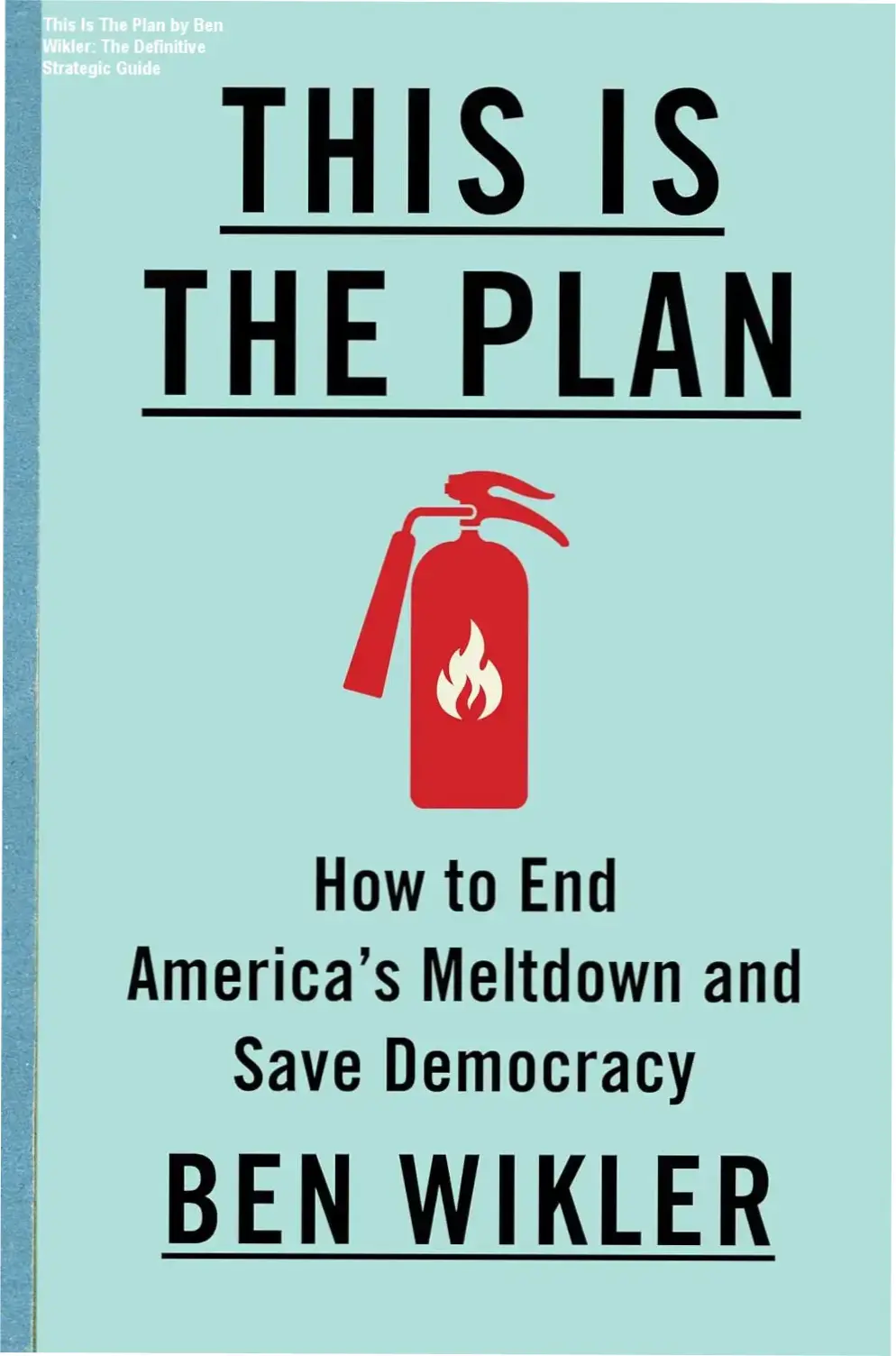
This Is The Plan by Ben Wikler: The Definitive Strategic Guide
Most people approach political crises with a mix of dread and paralysis. They watch the news, feel the ground shifting beneath their feet, and wonder if the democratic machinery is simply too rusted to be fixed. The common misconception is that saving a system requires a miracle or a sudden shift in national consciousness.
Ben Wikler argues the opposite: democracy isn’t saved by hope, but by precise, tactical execution. For those exhausted by theoretical debates, This Is The Plan arrives not as a manifesto, but as a field manual for political survival. It targets the specific anxiety of the “democracy desert”—the feeling that the game is rigged and the outcome is predetermined.
Ready to dive into “This Is The Plan”?
Explore available editions, check current live pricing, or download a free sample directly on Amazon.
Preview Free Sample & Check Price on Amazon
*You will be redirected to Amazon. As an Amazon Associate, we may earn from qualifying purchases.
The Operative’s Voice: Style and Pacing
Wikler doesn’t write like a political scientist. He writes like a campaign manager who hasn’t slept in three days and has a map of Wisconsin pinned to his wall. The prose is urgent, conversational, and stripped of academic fluff.
The pacing is aggressive. He moves quickly from the “why” to the “how,” treating the reader like a recruit in a high-stakes operation. This is a deliberate choice. By avoiding the dry tone of typical political literature, he transforms the reading experience into a briefing.
However, the “insider” energy can be polarizing. If you are looking for a neutral analysis of American sociology, this isn’t it. Wikler is an operative; he is playing to win. The text reflects that bias, prioritizing efficacy over neutrality.
The “Wisconsin Model” and Technical Strategy
The core of the book is a case study in survival. Wikler focuses on Wisconsin—a state he describes as a “democracy desert” due to its rigged structures. He uses this as a microcosm for the rest of the United States.
His analysis of “hidden structures of power” is where the book provides the most value. He breaks down how local races—even those as obscure as county coroner—can be leveraged to build the infrastructure needed for presidential victories.
He introduces the concept of “dictator-proofing” the government. This isn’t just about voting; it’s about building redundancies in the system so that no single individual can dismantle democratic norms without facing systemic friction.
| Technical Element | Traditional Approach | The Wikler Approach |
|---|---|---|
| Campaign Focus | Broad national messaging | Hyper-local infrastructure |
| Goal | Winning an election | Building a permanent power base |
| Tactics | TV ads and rallies | Community organizing and structural reform |
Practical Takeaways: Moving the Needle
The most critical part of the book is the shift from the macro to the micro. Wikler spends significant time answering the question: “What do I actually do on Tuesday morning?”
He argues that the path out of political wilderness is “people-powered.” This sounds like a cliché until he explains the science of organizing. He details how to reconnect with neighbors and turn social friction into political fuel.
The book suggests that joy is a strategic asset. By framing the fight for democracy as “storming the castle” in a metaphorical sense, he attempts to replace political burnout with a sense of adventurous purpose.
“If we do what this book says, we will win.” — Nancy Pelosi
This endorsement highlights the book’s intent. It is designed to be a blueprint for the Democratic establishment and its grassroots base, focusing on the art and science of winning in a divided landscape.
Expectation vs. Reality: Is it a Manual or a Manifesto?
Coming into this book, many readers expect a lamentation on the state of the union. Instead, they get a strategic playbook. The “reality” of the book is far more pragmatic than the “expectation” of a political critique.
Some critics on platforms like Goodreads note that the book can feel overly optimistic about the power of organizing. There is a risk of oversimplifying the deep-seated cultural divides that define the MAGA movement.
Yet, for the target audience—those who feel helpless—the pragmatism is the point. It replaces the existential dread of “the end of democracy” with a checklist of actionable tasks.
Who Should Actually Read This Book?
This isn’t a textbook on political science. It’s a field manual from a political operative. If you are a community organizer, a political strategist, or a citizen feeling paralyzed by the current state of American democracy, this is your blueprint.
The ideal reader is someone who has moved past the “what is happening” phase and is now asking “how do we stop it.” Wikler targets those who understand that voting once every four years is insufficient and are looking for the actual mechanics of power—the “hidden structures” that decide elections in swing states.
Who should skip this book:
- The Neutral Academic: If you are looking for a non-partisan, detached sociological study of authoritarianism, you’ll find this too biased.
- The “Quick-Fix” Seeker: If you expect a 10-step checklist that solves the national crisis in a weekend, you’ll be disappointed. This is a strategic narrative, not a cheat sheet.
- The Apolitical: If you have no interest in the granular details of voter registration or local precinct battles, this will feel like a slog.
Value for Money: Investment vs. Outcome
From a purely analytical standpoint, the value of This Is The Plan depends on your intent. As a casual read, it’s a compelling look at the “democracy desert” of Wisconsin. As a professional resource, it’s an investment in strategic intelligence.
The common purchasing mistake here is treating this as a “political memoir.” While it contains anecdotes (including a bizarre race for county coroner), the real value lies in the distillation of lessons from the front lines. You aren’t paying for a story; you’re paying for a methodology on how to “dictator-proof” a government.
Editorial Verdict: Does it Deliver?
Wikler succeeds in bridging the gap between high-level political theory and street-level organizing. He avoids the trap of blind optimism, acknowledging how “rigged” the system can be, while providing a pragmatic path forward.
The skepticism arises when considering scalability. Can the “Wisconsin Model” be replicated in every state? Perhaps not perfectly. However, the core principle—people-powered organization over top-down messaging—is a timeless political truth.
If you want to move from anxiety to action, this is the most strategic guide available right now. We suggest checking the latest reader reviews and current pricing on Amazon to see if the hardcover fits your budget.
Final Editorial Verdict
“This Is The Plan” delivers on its core promise for its intended audience, offering compelling insights without fluff. As highlighted in our detailed edition breakdown, its practical depth and readability are its greatest strengths.
We also recommend checking the official Kindle sample and reader ratings before making your final purchase decision.
*You will be redirected to Amazon. As an Amazon Associate, we earn from qualifying purchases.