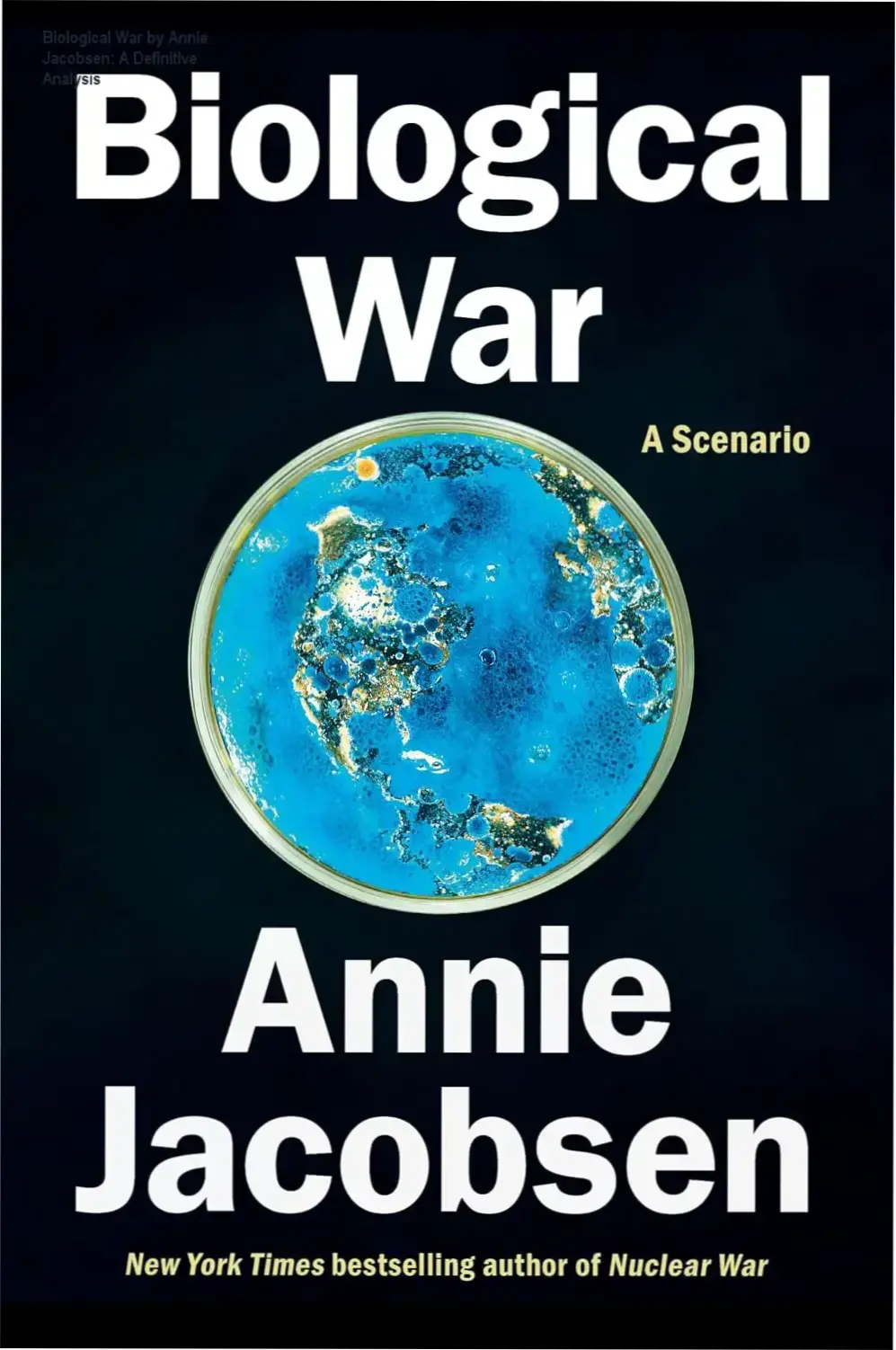
Biological War by Annie Jacobsen: A Definitive Analysis
Most of us spend our lives fearing the “big bang”—the nuclear flash, the sudden earthquake, or the cinematic asteroid. We are conditioned to look for the mushroom cloud, a visible signal that the world has ended. But the real nightmare isn’t a blast; it’s a sneeze, a leaked vial, or a microscopic organism that doesn’t care about borders, bunkers, or diplomatic treaties.
Annie Jacobsen enters this psychological minefield with a cold, clinical precision. In a world still reeling from the collective trauma of a global pandemic, her latest work doesn’t offer comfort. Instead, it provides a roadmap to the abyss, forcing readers to confront the fragility of the systems we trust. You can check the current reader reception and availability to see why this has become an immediate obsession for those who prefer their warnings unfiltered.
Ready to dive into “Biological War: A Scenario”?
Explore available editions, check current live pricing, or download a free sample directly on Amazon.
Preview Free Sample & Check Price on Amazon
*You will be redirected to Amazon. As an Amazon Associate, we may earn from qualifying purchases.
The “Ticking Clock” Architecture: Pacing as a Weapon
Jacobsen doesn’t write traditional non-fiction; she writes chronological dread. The structure of Biological War is designed to mimic the very thing it describes: a rapid, uncontrollable escalation.
By framing the book as a “scenario,” she removes the safety net of historical distance. She isn’t just telling you what happened in 1945 or 1970. She is showing you what happens in hour one, day three, and week two of a biological release.
This pacing creates a claustrophobic reading experience. The prose is stripped of fluff, delivering high-density information in short, sharp bursts. It feels less like a book and more like a leaked intelligence briefing.
Critics on platforms like Goodreads often note that the “ticking clock” mechanism makes the 432 pages fly by, but it leaves the reader in a state of heightened anxiety. It is an intentional choice: the pacing is the point.
Invisible Horror vs. The Mushroom Cloud
The core intellectual pivot of this book is the contrast with Jacobsen’s previous hit, Nuclear War: A Scenario. Nuclear war is loud, blinding, and instantaneous. It is a spectacle of destruction.
Biological warfare, as Jacobsen argues, is the opposite. It is silent. It is invisible. It begins with something so small that by the time you notice it, the game is already over.
She dissects the terrifying reality that the “weapon” here isn’t a missile, but biology itself. The horror lies in the lag time—the period between the release of the agent and the realization that society is collapsing.
This distinction shifts the reader’s fear from “will it happen?” to “is it happening right now?” It turns every cough in a crowded airport into a potential plot point in a global tragedy.
| Feature | Nuclear Scenario | Biological Scenario |
|---|---|---|
| Visibility | Immediate / Blinding | Invisible / Latent |
| Detection | Instant (Radar/Flash) | Delayed (Clinical Diagnosis) |
| Societal Decay | Rapid Physical Destruction | Gradual Institutional Collapse |
| Primary Fear | The Explosion | The Contagion |
Institutional Fragility: The Myth of the Safety Net
One of the most cynical—and necessary—aspects of the book is Jacobsen’s analysis of our infrastructure. She interviews high-level military and medical experts to expose a sobering truth: we are not ready.
The book dismantles the illusion that “government protocols” can
Who Should Actually Read This?
This isn’t a book for the faint of heart. It is specifically engineered for the “worst-case scenario” thinkers—the audience that devoured Nuclear War: A Scenario and craved that same clinical, terrifying precision.
If you are obsessed with biosecurity, the fragility of global infrastructure, or the intersection of military intelligence and medicine, this is your territory. It appeals to the analytical mind that prefers a cold, hard look at catastrophe over sanitized government reports.
Who should skip this:
- Pandemic-fatigued readers: If the mere mention of a global biological threat triggers anxiety, this book will only amplify it.
- Survivalists seeking a “how-to” guide: This is journalistic reporting, not a prepper’s manual. You will find a roadmap of collapse, not a list of supplies to stockpile.
- Casual non-fiction readers: If you prefer uplifting narratives or optimistic forecasts, Jacobsen’s relentless focus on dystopia will feel oppressive.
Value for Money: Investment vs. Expectation
At 432 pages, you aren’t paying for a superficial summary. The real value lies in the exclusive access. Jacobsen leverages dozens of interviews with high-level political, medical, and military figures who typically operate in the shadows.
A common purchasing mistake is expecting a medical textbook. This is not a study on virology. Instead, it is a study of systemic failure. You are paying for the narrative architecture that transforms dry data into a ticking-clock experience.
Editorial Verdict: The Cold Truth
Jacobsen succeeds in making the invisible visible. While a nuclear blast is a visual spectacle, biological warfare is a slow, creeping erasure. The book is an essential, if haunting, piece of forward-looking journalism.
It forces a confrontation with the reality that our modern infrastructure is a house of cards. If you want to understand the specific mechanics of societal collapse in the 21st century, it is a mandatory read. You can verify the latest user ratings and current availability on the official product page.
Final Editorial Verdict
“Biological War: A Scenario” delivers on its core promise for its intended audience, offering compelling insights without fluff. As highlighted in our detailed edition breakdown, its practical depth and readability are its greatest strengths.
We also recommend checking the official Kindle sample and reader ratings before making your final purchase decision.
*You will be redirected to Amazon. As an Amazon Associate, we earn from qualifying purchases.