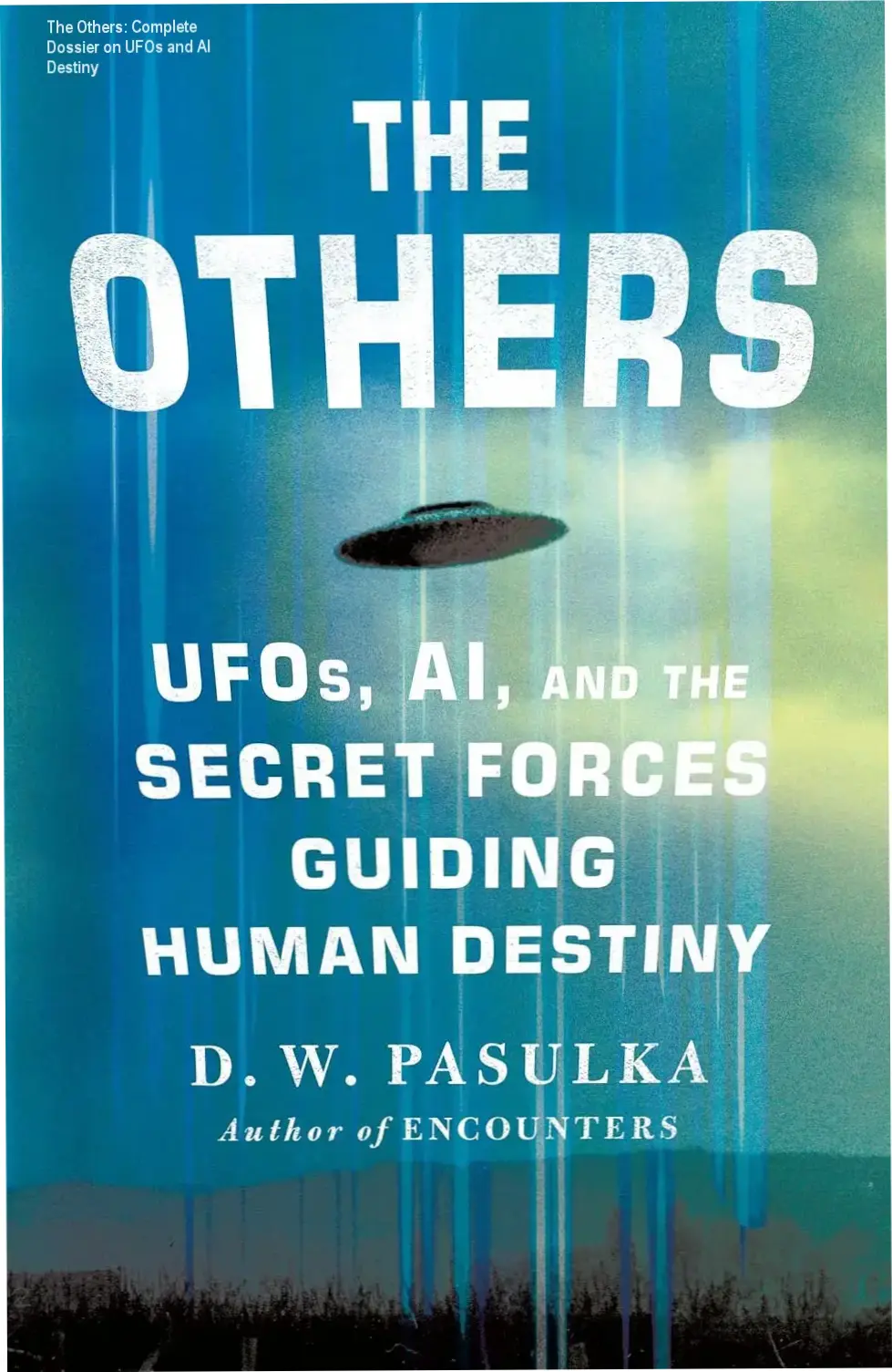
The Others: Complete Dossier on UFOs and AI Destiny
We have spent decades arguing whether “they” are out there, trapped in a loop of grainy footage and government denials. But the conversation has shifted. The real tension now lies in the uncomfortable intersection where cutting-edge artificial intelligence meets ancient, unexplained encounters.
Most readers enter this topic expecting a conspiracy manifesto. Instead, D. W. Pasulka offers a scholarly dissection of how we perceive non-human intelligence. If you want to see how the academic world is finally treating UAPs with seriousness, you can check the current reception and availability of The Others on Amazon.
Ready to dive into “The Others: UFOs, AI, and the Secret Forces Guiding Human Destiny”?
Explore available editions, check current live pricing, or download a free sample directly on Amazon.
Preview Free Sample & Check Price on Amazon
*You will be redirected to Amazon. As an Amazon Associate, we may earn from qualifying purchases.
The Scholar vs. The Conspiracy Theorist
Let’s be honest: the UFO genre is cluttered with noise. Most books are either blindly believing or aggressively debunking. Pasulka takes a third path. She is a scholar of religious studies, and that is her secret weapon.
She doesn’t approach “The Others” as a hunt for little green men. She approaches it as a study of human belief and the architecture of influence. It is a pivot from “Are they real?” to “Why do we believe this, and who is benefiting from the narrative?”
This academic distance is refreshing. It strips away the tinfoil hat tropes and replaces them with ethnographic research. She treats the experience of the “contactee” as a sociological data point rather than a gospel truth.
However, for the hardcore skeptic, this might feel like a dance. Pasulka avoids definitive claims, opting instead to explore the “hidden history.” It’s a sophisticated way of presenting provocative ideas without risking professional suicide.
The Convergence: Where Silicon Meets the Sacred
The most provocative argument in the book is the link between UAPs and Artificial Intelligence. Pasulka suggests that our obsession with AI is not just a tech race, but a subconscious mirror of our desire to communicate with non-human intelligence.
She posits that we are essentially building the “Others” here on Earth. The dream of immortality, life extension, and the merging of consciousness with machines isn’t just Silicon Valley hubris—it’s a modern iteration of an ancient spiritual quest.
This is where the book gets dense. She weaves together Catholic mysticism and Arthur C. Clarke’s visions of the future. The narrative suggests that the 21st century is a “critical threshold” where the synthetic and the sacred finally collide.
It is a bold claim. Whether you buy into it depends on your tolerance for speculative synthesis. She isn’t providing a mathematical proof; she is building a philosophical bridge.
| Feature | Traditional UFO Books | The Others (Pasulka) | ||||||
|---|---|---|---|---|---|---|---|---|
| Primary Lens | Anecdotal/Conspiratorial | Academic/Religious Studies | ||||||
| Core Goal |
| Common Question | Direct Answer |
|---|---|
| Is this a sci-fi novel? | No. It is a non-fiction analysis based on interviews and historical research. |
| Does it prove UFOs exist? | It explores the implications of their existence and the history of contact reports. |
| Is it too religious? | It uses religious studies as a lens, but the focus is on the evolution of consciousness. |
Editorial Conclusion
D.W. Pasulka succeeds in creating a bridge between the sacred and the synthetic. While the narrative occasionally leans heavily on the speculative, the intellectual rigor of the research keeps it grounded. It is a provocative piece of work that challenges the reader to redefine what “intelligence” actually means in the 21st century.
If you want to see how the dots connect between ancient prophecy and the singularity, it’s worth the investment. We suggest checking the latest reader ratings and pricing on Amazon to see if the current edition fits your budget.
Final Editorial Verdict
“The Others: UFOs, AI, and the Secret Forces Guiding Human Destiny” delivers on its core promise for its intended audience, offering compelling insights without fluff. As highlighted in our detailed edition breakdown, its practical depth and readability are its greatest strengths.
We also recommend checking the official Kindle sample and reader ratings before making your final purchase decision.
*You will be redirected to Amazon. As an Amazon Associate, we earn from qualifying purchases.
Posts Similares
I’ve Got A Crush On You: Lauren Blakely Review & Dossier
Have you ever experienced that sudden, jarring collision between your professional boundaries and an unexpected romantic spark? We often tell ourselves that we have mastered the art of compartmentalization—that a failed workplace romance is enough to make us swear off ” चीजोंulho” forever. Yet, the human heart rarely follows a professional handbook, often choosing the…
Adversary to the Villain: The Definitive Reader’s Dossier
We have all experienced that specific corporate dread: being assigned a role we never applied for, usually right as the project is crashing. It is the “promotion” that is actually just more work with a fancier, more stressful title. This is the precise human friction Hannah Nicole Maehrer leverages in her latest installment of the…
The Price of Honey: Complete Dossier on Moriarty’s Thriller
We have a morbid fascination with the collapse of “perfect” empires. There is something deeply satisfying about watching a tech billionaire—a man who spent his life optimizing every variable—finally lose control of the one thing that matters: his legacy. Liane Moriarty understands this craving for domestic destruction. In The Price of Honey, she strips away…
The Secrets We Hide: The Definitive North Falls Dossier
Most of us grow up believing that the quietest neighborhoods are the safest. We equate manicured lawns and silent streets with peace, ignoring the reality that silence is often just a mask for things people are too terrified to discuss openly. Karin Slaughter understands this paradox better than almost any contemporary thriller writer. In her…
Lock Every Door by Riley Sager: The Definitive Analysis
Most of us have fantasized about a clean slate—a sudden opportunity to escape a crumbling personal life and move into a place where the rent is paid and the views are breathtaking. It is the ultimate urban fantasy: the high-end luxury apartment where the only rule is to stay out of the way. But in…
If You Tell Review: Dark Family Secrets Exposed
We need to produce the first part of an analytical book review. Must start with a contextualization paragraph (between 180-320 words). Must include exactly 1 contextual affiliate link in first or second paragraph using tag “Link_afiliado”. Use the provided affiliate URL: https://amzn.to/4z5IaR5 . Must use the tag ? Actually they said “Insert exactly 1 contextual…