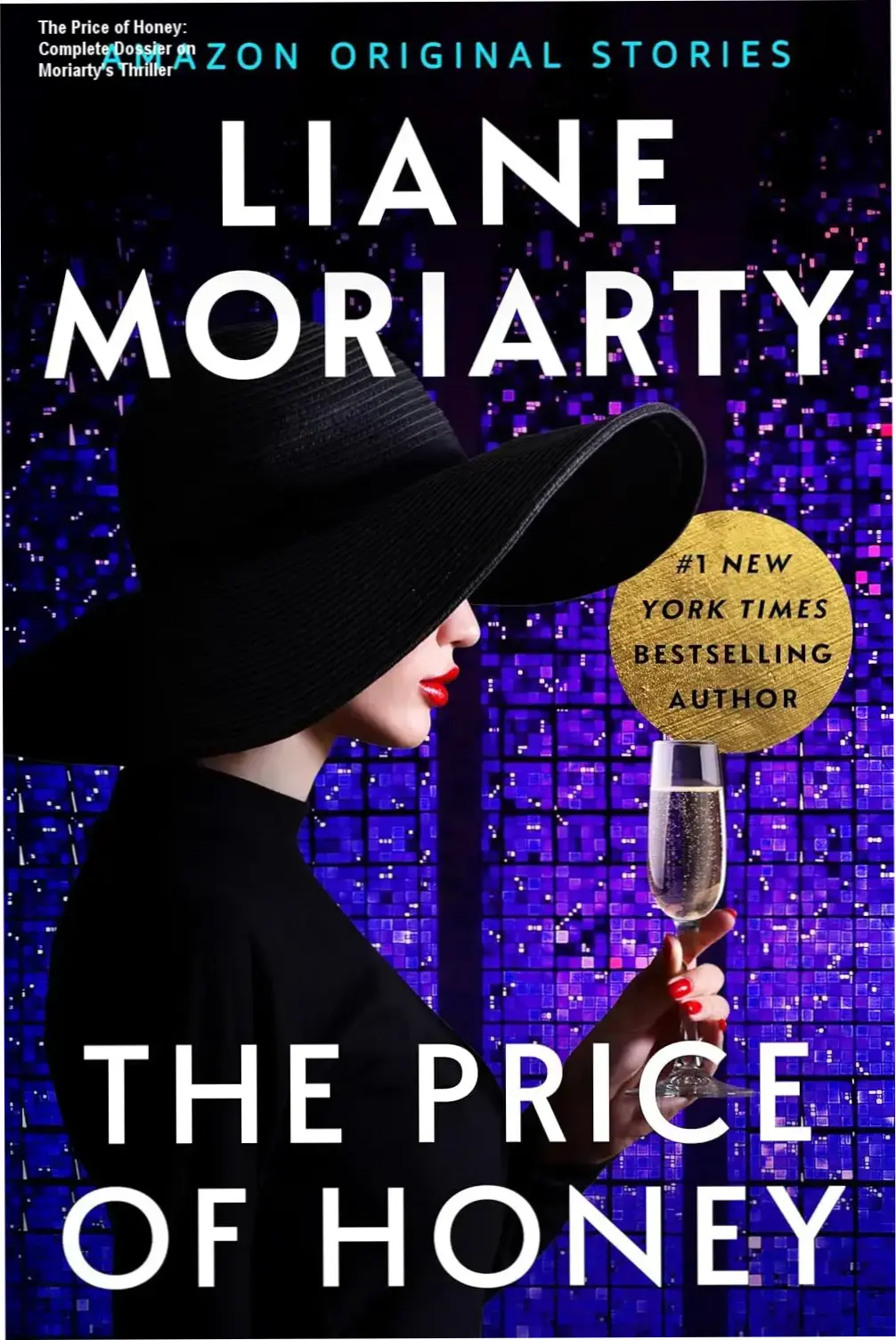
The Price of Honey: Complete Dossier on Moriarty’s Thriller
We have a morbid fascination with the collapse of “perfect” empires. There is something deeply satisfying about watching a tech billionaire—a man who spent his life optimizing every variable—finally lose control of the one thing that matters: his legacy.
Liane Moriarty understands this craving for domestic destruction. In The Price of Honey, she strips away the glossy veneer of wealth to expose the raw, ugly nerves of greed and resentment. It is a study in power dynamics disguised as a funeral gathering.
Ready to dive into “The Price of Honey”?
Explore available editions, check current live pricing, or download a free sample directly on Amazon.
Preview Free Sample & Check Price on Amazon
*You will be redirected to Amazon. As an Amazon Associate, we may earn from qualifying purchases.
The “Short Read” Paradox: Density vs. Length
At just 34 pages, this isn’t a novel; it’s a literary surgical strike. Moriarty doesn’t have room for fluff, and that is where the story succeeds. She manages to establish a complex web of resentment in the time it takes to drink a cup of coffee.
However, for some readers, this brevity is a double-edged sword. On Goodreads and Amazon, a recurring critique is the “cliff-like” ending. When you are used to Moriarty’s sprawling domestic dramas, a “short read” can feel like an appetizer when you were expecting a full course meal.
But if you approach it as a character study rather than a plot-driven thriller, the pacing is flawless. Every line serves a purpose. Every interaction between the widows is a calculated move in a high-stakes game of social chess.
| Technical Metric | Analysis |
|---|---|
| Print Length | 34 Pages (Ultra-Compact) |
| Reading Time | Approx. 45-60 Minutes |
| Narrative Pace | Accelerated / High Tension |
| Genre Fit | Domestic Suspense / Satire |
The Architecture of Betrayal
The setting is a masterclass in tension: a funeral. It is the only place where people who hate each other are socially obligated to be polite. Moriarty uses this friction to fuel the narrative.
The protagonist, Honey Beckett, is the “young widow.” She is the current prize, but she is surrounded by the ghosts of Barney’s past—Rita, Svetlana, and Meredith. These aren’t just ex-wives; they are mirrors showing Honey where she is headed.
The core conflict isn’t about grief. It is about ownership. The “Price of Honey” isn’t just a play on the character’s name; it’s a question of what it costs to be the companion of a controlling genius. The betrayal isn’t just financial; it’s psychological.
“Control is a drug. For Barney, it was the only thing more addictive than the wealth he created.”
Expectation vs. Reality: The “Bingeable” Promise
Amazon markets this as part of the “Deadly Ambition” collection, promising “bingeable” stories. In reality, the experience is more like a series of psychological sketches. It doesn’t provide the catharsis of a 400-page mystery, but it offers a sharper, more cynical insight into human nature.
Many readers enter the story expecting a “Who-Done-It.” While there is a reversal of fortune, the real pleasure is the “How-They-Did-It.” The satisfaction comes from the irony of a man who controlled everything being outmaneuvered in death.
The writing style is direct and razor-sharp. Moriarty avoids overly poetic descriptions, opting instead for dialogue that cuts. It feels modern, clinical, and slightly cold—which perfectly matches the theme of a tech billionaire’s inner circle.
Reader Sentiment: The Consensus
Looking at the 30,000+ ratings on Amazon and the 38,000+ on Goodreads, the sentiment is polarized. The 3.5 to 3.7-star average reveals a divide between “efficiency seekers” and “depth seekers.”
The critics argue that the story ends too abruptly, leaving them wanting more development. The fans, however, praise the “punch to the gut” efficiency. They appreciate that Moriarty can deliver a complete emotional arc in under 40 pages.
On Reddit, discussions often center on the relatability of the “controlling partner” trope. Readers find the depiction of Barney—even in his absence—disturbingly accurate to the archetype of the visionary who views people as assets to be managed.
Posts Similares
Noelle Marshall Series: The Definitive Suspense Dossier
Most of us believe that time heals all wounds, or at least buries them deep enough to be forgotten. But for those haunted by a “cold case,” the past isn’t a memory—it’s a predator waiting for the right moment to resurface. When the FBI reopens a thirteen-year-old murder, it doesn’t just bring back evidence; it…
Access to Benjamin Franklin: An American Life – Full Review
We need to output only the first part of a professional analytical book review, starting with a paragraph of contextualization, 180-320 words, with exactly 1 contextual affiliate link using tag “Link_afiliado”. Then after that, insert the featured CTA card HTML block. Then the reading experience section (900-1600 words) with 4-6 thematic blocks, integrate reader feedback,…
Shadow and Bone Trilogy Boxed Set: The Definitive Guide
Most of us have spent a lifetime feeling like a background character in our own stories, waiting for a catalyst to change the trajectory of a mundane existence. This universal longing for “hidden potential” is exactly why the “Chosen One” trope persists, though it often falls into the trap of being predictable and hollow. Leigh…
The Tomorrow Tree: A Technical Review of Carolyn Brown
Have you ever felt the urge to run away from everything that defines you? We often mistake distance for healing, thinking a change of scenery can erase the scars of betrayal or past mistakes. Returning home is rarely a straight path; it is usually a messy, emotional confrontation with the versions of ourselves we left…
Dawn of the Cursed Queen: The Definitive Deluxe Dossier
The modern reader’s appetite for “Romantasy” has evolved beyond simple magic and kissing. We are now in an era of high-stakes political intrigue where the romantic tension is often as grueling as the actual war. The challenge for any author in this saturated market is avoiding the “middle-book slump,” where plot armor becomes too thick…
Pokécology: The Complete Scientific Dossier on Pokémon
Most Pokémon fans treat the Pokédex as a digital checklist—a set of stats, types, and brief, often contradictory snippets of lore. We accept that a Magcargo is hotter than the sun without questioning how that fits into a functioning planetary ecosystem. We play the game, but we rarely stop to ask how these creatures actually…