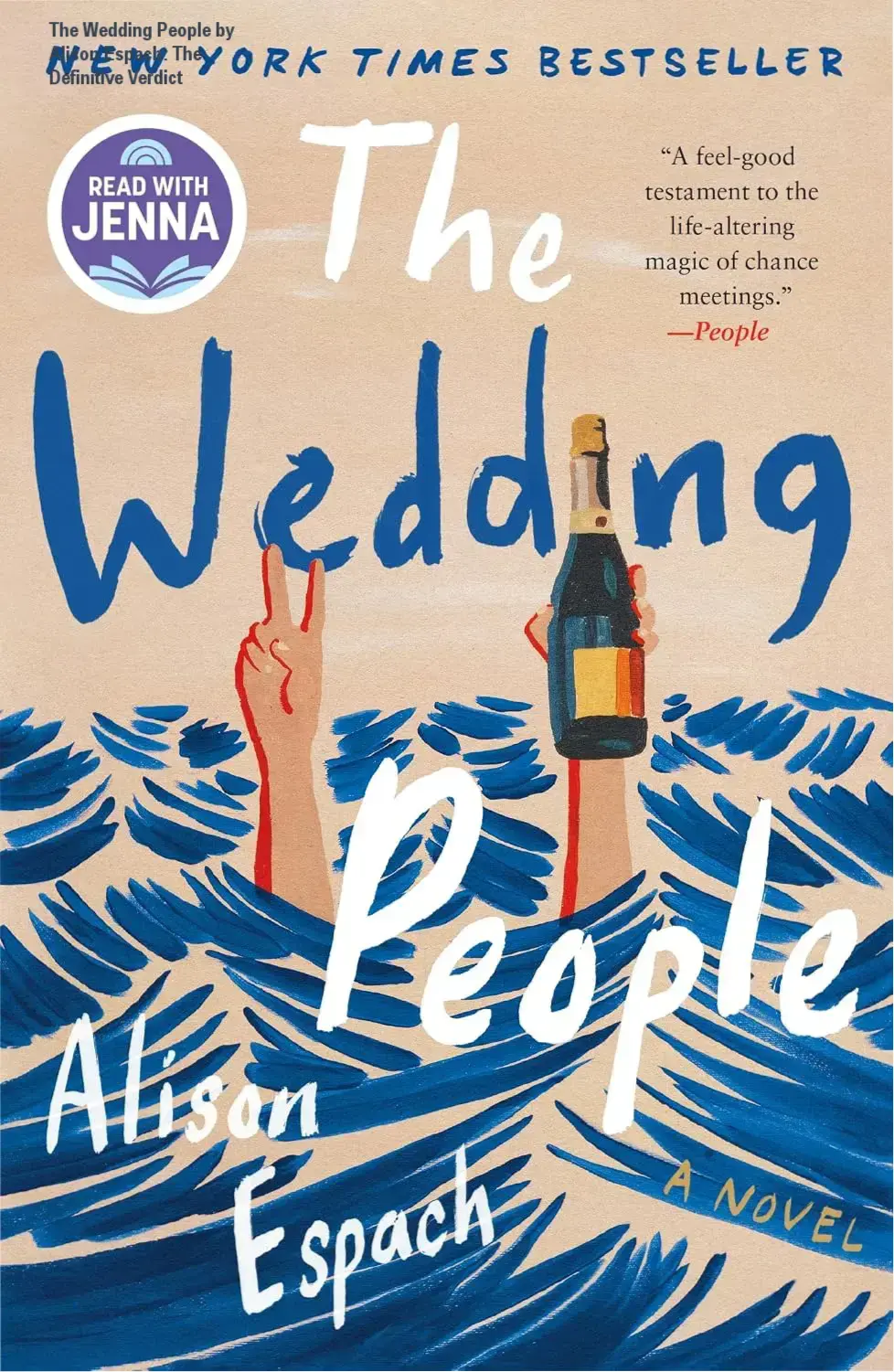
The Wedding People by Alison Espach: The Definitive Verdict
We have all had those moments where life feels like a series of catastrophic errors leading to a dead end. That specific, suffocating feeling of being “at rock bottom” is rarely portrayed with honesty in fiction; it is usually glossed over for a quick redemption arc or drowned in melodrama.
Alison Espach takes a different route in The Wedding People, placing a woman in her darkest hour right in the middle of society’s most curated celebration of love. If you have ever felt like an impostor in your own life, checking the current reader reception of this novel will show you why this particular narrative of despair and unexpected connection has resonated with over 1.5 million readers.
Ready to dive into “The Wedding People”?
Explore available editions, check current live pricing, or download a free sample directly on Amazon.
Preview Free Sample & Check Price on Amazon
*You will be redirected to Amazon. As an Amazon Associate, we may earn from qualifying purchases.
The Anatomy of Contrast: Humor vs. Devastation
Espach operates on a frequency of high contrast. The setting is Newport, Rhode Island—the epitome of old-money luxury, gold heels, and meticulously planned weddings. Then there is Phoebe Stone.
Phoebe arrives at the Cornwall Inn not to celebrate, but because she is fundamentally broken. She has no luggage, no plan other than a final splurge, and a level of grief that makes the surrounding wedding festivities look like a surrealist play.
The pacing is deceptive. It starts with the awkwardness of a mistaken identity, but it quickly pivots into a sharp analysis of mental collapse. The “absurdly funny” elements aren’t there to lighten the mood; they are there to highlight the absurdity of trying to maintain a facade when your world has already ended.
This isn’t a “beach read,” despite the coastal setting. It is a surgical examination of how we survive the unthinkable by clinging to the most unlikely people.
The Friction of Connection: Phoebe and the Bride
The narrative engine of the book is the relationship between Phoebe and the bride. On paper, they are opposites: one is the architect of a perfect weekend, the other is the embodiment of chaos and failure.
However, the brilliance of the writing lies in how quickly these two women stop performing. The bride, burdened by the crushing weight of perfectionism, finds in Phoebe the only person she doesn’t have to impress.
Their confidences are raw. They don’t trade platitudes. Instead, they trade truths that would be socially unacceptable at a wedding reception. This creates a tension that keeps the pages turning—not because of a plot twist, but because of emotional honesty.
“It is the chance encounters that reroute us when we think the road has ended.”
This core sentiment drives the plot. The book argues that the most authentic versions of ourselves often emerge only after we have lost everything and no longer have a reputation to protect.
Technical Breakdown: The Reader’s Perspective
Analyzing the data from Goodreads and Amazon, the consensus is clear: the book succeeds because it avoids the “toxic positivity” trap. Readers appreciate that Phoebe’s depression is handled with nuance rather than as a plot device for a quick fix.
The prose is lean. Espach doesn’t waste time with excessive descriptions of the Newport scenery. She focuses on the internal dialogue and the sharp, often biting, exchanges between characters.
| Metric | Analysis | Verdict |
|---|---|---|
| Pacing | Fast-start, slows down for emotional depth | Engaging |
| Emotional Weight | High (deals with loss and rock bottom) | Intense |
| Character Arc | Non-linear, realistic recovery | Authentic |
| Dialogue | Sharp, witty, and occasionally brutal | Elite |
Expectation vs. Reality: Is it a Rom-Com?
If you pick this up expecting a lighthearted story about a wedding crasher, you are in for a shock. The “Wedding People” in the title refers to the roles we play, not the romance of the event.
The reality is a story about the “winding paths” of life. It explores the idea that rock bottom is not just a place of pain, but a place of absolute clarity. When you have nothing left to lose, you are finally free to be honest.
Many readers on Reddit have noted that the book feels like a “cleansing” experience. It acknowledges the ugliness of grief while still offering a glimmer of hope that isn’t forced or sentimental.
The “Rock Bottom” Learning Curve
Reading this book requires a certain emotional readiness. It doesn’t
Who This Book Is Actually For
The Wedding People isn’t a typical “beach read,” despite the Rhode Island setting. It is designed for the reader who enjoys literary fiction with a jagged edge—stories where humor is used as a survival mechanism against profound grief.
If you gravitate toward narratives like Eleanor Oliphant Is Completely Fine or the works of Fredrik Backman, this is your territory. It appeals to those who prefer character studies over plot-driven fireworks and who find beauty in the “ugly” parts of a mental breakdown.
Who Should Probably Skip It
Avoid this book if you are currently seeking “comfort reads” or pure escapism. While there is humor, it is often dark and laced with desperation.
- The Rom-Com Purist: If you want a predictable “will-they-won’t-they” wedding trope, you’ll find the emotional weight here too heavy.
- The Fast-Pace Junkie: This is a slow-burn exploration of human connection, not a high-stakes thriller.
- The Optimism-Only Reader: The book dwells in “rock bottom” for a significant portion of the narrative.
The “Value” Equation: Is It Worth Your Time?
At 384 pages, the value here isn’t in the “what happens next,” but in the emotional resonance. Many readers make the mistake of expecting a lighthearted comedy of errors. In reality, you are paying for a nuanced autopsy of loss and the unexpected ways strangers can reroute our lives.
The prose is tight, and the dialogue feels authentic rather than scripted. From a “cost-per-insight” perspective, the book delivers high value by challenging the reader’s perception of happiness and social performance.
Quick Verdict FAQ
| Common Question | Analytical Answer |
|---|---|
| Is it too depressing? | No. The “absurdly funny” elements act as a necessary counterbalance to the tenderness. |
| Is the ending satisfying? | It avoids easy clichés, opting for a resonant, realistic conclusion instead of a fairy tale. |
| Is it a “wedding book”? | Only on the surface. The wedding is the catalyst, not the destination. |
Final Editorial Take
Alison Espach has managed to capture the precise moment where total surrender meets a second chance. It is a sophisticated piece of writing that refuses to patronize the reader with easy answers about healing. It is an investment in a story that feels human, flawed, and ultimately necessary.
If you are ready for a narrative that balances devastation with wit, we suggest checking the latest reader reviews and pricing for The Wedding People to see if it aligns with your current reading mood.
Final Editorial Verdict
“The Wedding People” delivers on its core promise for its intended audience, offering compelling insights without fluff. As highlighted in our detailed edition breakdown, its practical depth and readability are its greatest strengths.
We also recommend checking the official Kindle sample and reader ratings before making your final purchase decision.
*
Posts Similares
The Secrets We Hide: The Definitive North Falls Dossier
Most of us grow up believing that the quietest neighborhoods are the safest. We equate manicured lawns and silent streets with peace, ignoring the reality that silence is often just a mask for things people are too terrified to discuss openly. Karin Slaughter understands this paradox better than almost any contemporary thriller writer. In her…
Maggie O’Farrell Land: Definitive Audiobook Analysis
Historical fiction often struggles with the weight of its own research, burying human stories under sediment layers of period-accurate detail. Maggie O’Farrell has built a career defying that gravity. After the intimate domestic tragedy of Hamnet and the courtly pressure cooker of The Marriage Portrait, she turns her gaze to the Irish west coast in…
How to Ruin a Wedding: Elba Luz Full Technical Review
We have all been there: watching a wedding ceremony and feeling that creeping sense of doubt. Is it a beautiful union, or just another expensive contract destined to crumble? The concept of “happily ever after” is a heavy marketing tool that often ignores the messy, chaotic reality of human relationships and the financial drain of…
How to Ruin a Wedding Review: Why Elba Luz’s Rom-Com Wins
The wedding industrial complex sells a fantasy, but the reality usually involves open bars, family politics, and a sinking feeling that half the guests are secretly betting on the divorce. Elba Luz understands this cynicism better than most, building an entire premise around a protagonist who monetizes the chaos. Lucy Delgado isn’t a planner; she’s…
Lead Me Home: Definitive Analysis of Paranormal Romantic Suspense
Trust is a liability when your childhood was a masterclass in manipulation, and Luna Canning has the spreadsheets to prove it. As a forensic accountant, she structures her life around the only language that doesn’t lie: numbers. But ledgers can’t account for the chaos of a stolen car, a Victorian house that creaks with more…
If You Tell Review: Dark Family Secrets Exposed
We need to produce the first part of an analytical book review. Must start with a contextualization paragraph (between 180-320 words). Must include exactly 1 contextual affiliate link in first or second paragraph using tag “Link_afiliado”. Use the provided affiliate URL: https://amzn.to/4z5IaR5 . Must use the tag ? Actually they said “Insert exactly 1 contextual…