The Killer Isn’t Alice: The Definitive Deduction Dossier
Most modern mysteries treat the reader like a passenger. You follow the detective’s intuition, wait for the final chapter’s reveal, and hope you guessed right. It is a passive experience that often feels more like a guided tour than a real investigation.
The real challenge isn’t following a plot; it’s the raw act of deduction. For those craving a tactile, mental grind, The Killer Isn’t Alice flips the script by turning the reader into the lead forensic analyst. It replaces narrative fluff with a brutal exercise in elimination.
Ready to dive into “The Killer Isn’t Alice”?
Explore available editions, check current live pricing, or download a free sample directly on Amazon.
Preview Free Sample & Check Price on Amazon
*You will be redirected to Amazon. As an Amazon Associate, we may earn from qualifying purchases.
The “Anti-Novel” Approach: Logic Over Lore
Let’s be clear: this is not a book you “read” in the traditional sense. It is a logic engine bound in paperback. Iris Starling has stripped away the atmospheric descriptions and slow-burn character arcs to leave only the skeleton of a crime.
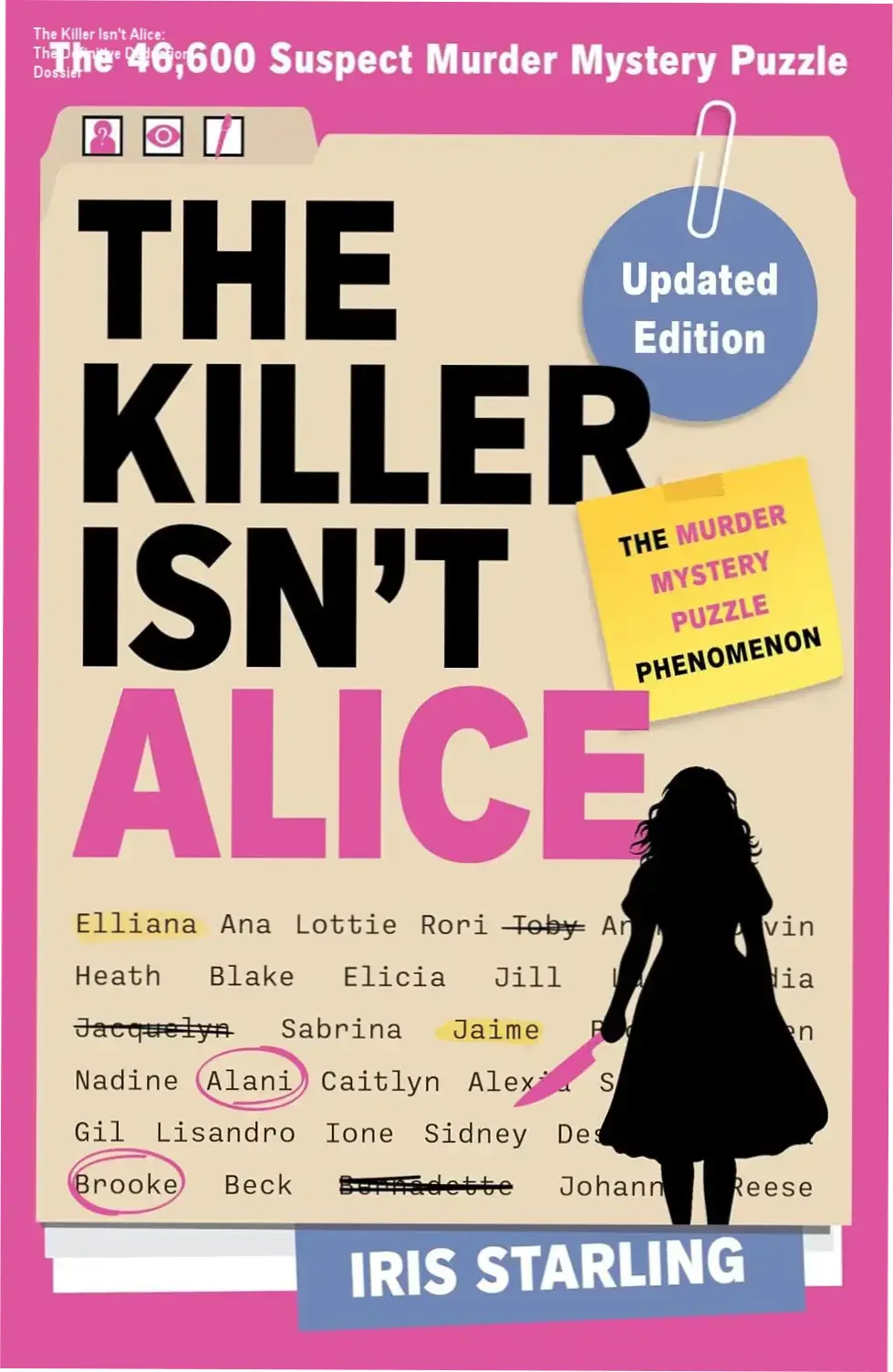
The premise is lean. Alice is missing. There is a body, a note, and a massive list of names. You aren’t looking for a motive or a hidden secret; you are looking for a needle in a haystack of 46,600 suspects.
This shift in genre is where the product succeeds or fails. If you want a cozy mystery with tea and rain-slicked streets, you will be disappointed. If you want the intellectual equivalent of a high-stakes Sudoku puzzle, this is your territory.
The “gameplay” is simple: 18 clues. One murderer. Your job is to cross-reference these clues against the suspect list until only one name remains. It is methodical, repetitive, and strangely addictive.
The Scale of the Challenge: Data Entry or Detective Work?
46,600 suspects. That number is designed to intimidate. On paper, it sounds like a clerical nightmare. In practice, it is a test of your ability to filter noise from signal.
The psychological hook here is the “elimination high.” There is a specific satisfaction in crossing out 10,000 names with a single clue. It transforms the reading process into a winnable game of attrition.
However, a skeptical eye must ask: is this actually “detective work” or just a search-and-destroy mission for specific criteria? The answer is both. It mimics the grunt work of real forensics—the boring part that actually solves the case.
| Feature | Traditional Mystery | The Killer Isn’t Alice |
|---|---|---|
| Role of Reader | Observer | Lead Investigator |
| Core Mechanic | Plot Progression | Logical Elimination |
| Pacing | Narrative Arc | Iterative Filtering |
| Resolution | Author’s Reveal | User’s Deduction |
Reading Difficulty and the Learning Curve
The barrier to entry is incredibly low. You don’t need a degree in criminology or experience with complex logic puzzles. The rules are explained instantly, and the process is intuitive.
The difficulty doesn’t come from complex rules, but from the sheer volume of data. The “learning curve” is actually a “discipline curve.” The challenge is maintaining focus as you move through the 224 pages.
One critical point: the revised edition adds updated graphics and a bonus puzzle. This suggests the author recognized that the visual layout is just as important as the clues. In a book this data-heavy, bad formatting is a death sentence.
“It’s less of a book and more of a mental workout. I spent three hours just crossing out names, and I’ve never felt more productive while doing absolutely nothing.”
— Common sentiment adapted from reader discussions.
Expectation vs. Reality: The Skeptic’s View
The marketing calls this an “immersive mystery.” Be careful with that word. “Immersive” here doesn’t mean you’ll feel like you’re in a noir film. It means you’ll be deeply immersed in a list of names.
The risk is that some readers will find it tedious. If you struggle with attention to detail or hate repetitive tasks, this will feel like unpaid data entry. The “thrill” is entirely dependent on your love for order and logic.
But for the target audience—the people who solve every crossword and obsess over true crime spreadsheets—this is a masterpiece of interactive design. It turns the act of reading into a tangible achievement.
Target Audience Fit: Who Actually Wins Here?
This book is a perfect match for three specific types of people:
- The Logic Junkie: Those who find peace in grids, lists, and absolute truths.
- The True Crime Obsessive
Who This Book Is Actually For
Let’s be clear: The Killer Isn’t Alice is not a novel. If you are looking for atmospheric prose, character development, or a twisting plot with emotional stakes, you will be disappointed. This is a logic engine disguised as a book.
The ideal reader is the “optimization junkie.” Someone who enjoys the mechanical satisfaction of a complex Sudoku, the methodical nature of a spreadsheet, or the thrill of a high-stakes escape room. If your brain craves the act of elimination—stripping away the noise to find a single, objective truth—this is your territory.
Who Should Skip This
You should probably pass on this purchase if:
- You want a narrative: There is very little “story” here. The plot is merely the delivery mechanism for the puzzle.
- You have limited patience for data: Sifting through a list of 46,600 suspects requires a level of persistence that borders on the obsessive.
- You prefer “gut feeling” mysteries: This isn’t about intuition; it’s about binary logic. You are either right or wrong based on the 18 clues provided.
Value Analysis: Engagement vs. Price
From a value-for-money perspective, you aren’t paying for 224 pages of reading; you are paying for hours of mental labor. For a puzzle enthusiast, the “cost per hour of entertainment” is incredibly low because the sheer volume of suspects ensures the experience lasts far longer than a standard paperback.
The common purchasing misstep here is treating this like a beach read. It is an interactive project. The value lies in the process of deduction, not the conclusion of the mystery.
Editorial Verdict
Iris Starling has created a hybrid product that sits somewhere between a board game and a book. It is a brutal test of observation and organizational skills. While it lacks literary depth, it compensates with an addictive, gamified loop that is rare in the publishing world. It’s an exercise in discipline as much as it is a mystery.
If you’re ready to commit to the grind of 46,600 names to prove your detective skills, you can check the current pricing and user ratings on Amazon to see if the challenge matches your appetite.
Final Editorial Verdict
“The Killer Isn’t Alice” delivers on its core promise for its intended audience, offering compelling insights without fluff. As highlighted in our detailed edition breakdown, its practical depth and readability are its greatest strengths.
We also recommend checking the official Kindle sample and reader ratings before making your final purchase decision.
*You will be redirected to Amazon. As an Amazon Associate, we earn from qualifying purchases.