The Killer Isn’t Alice: Complete Logic Challenge Dossier
Most murder mysteries are passive experiences. You sit back, let the author feed you clues, and hope you guess the killer before the final chapter. It is essentially a guided tour of someone else’s logic.
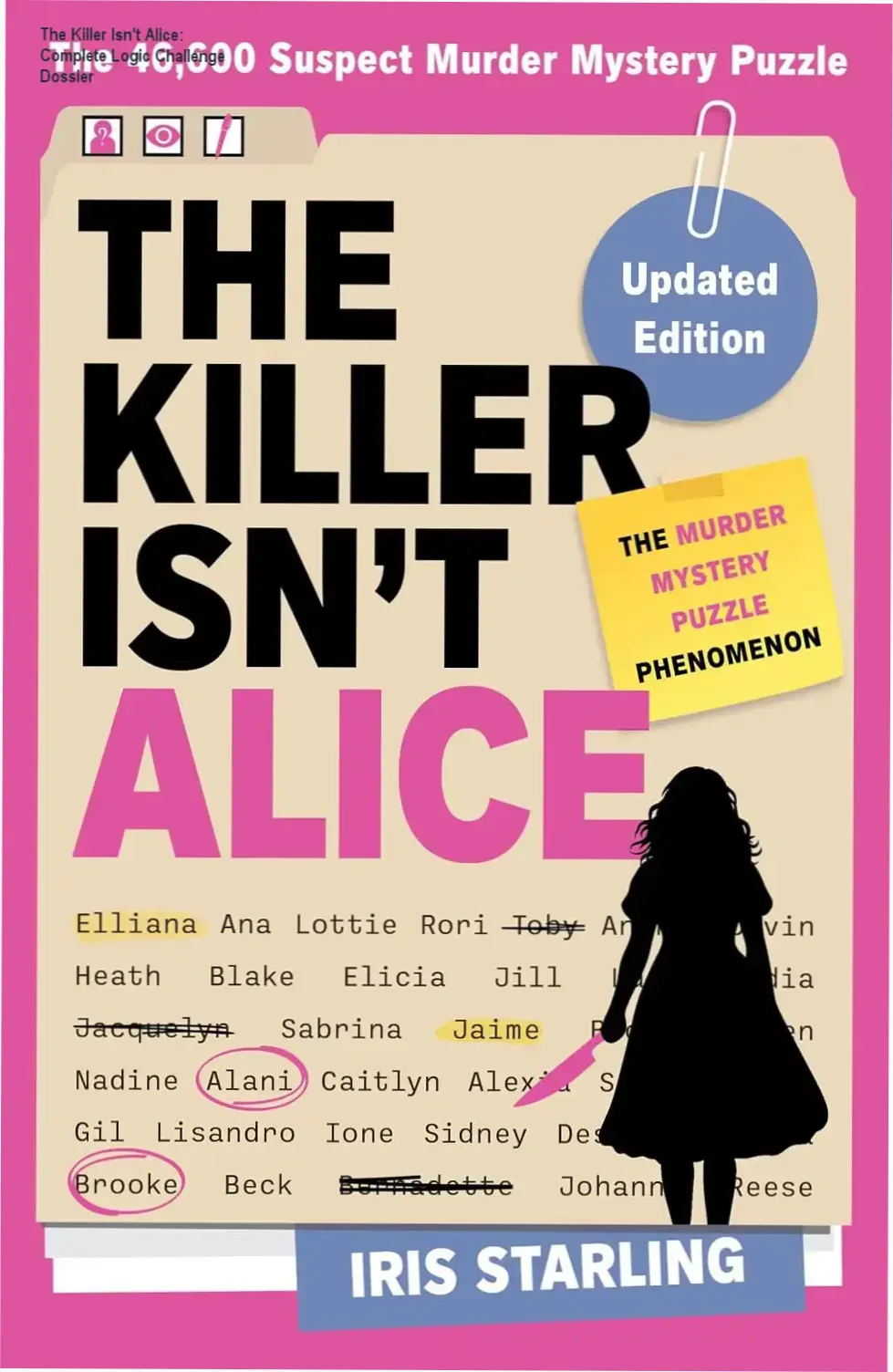
Then there is the “brute force” approach to deduction. Some readers are tired of being led by the hand and want the raw data—the digital equivalent of a police evidence locker. This is where The Killer Isn’t Alice enters the market, pivoting away from narrative prose toward a pure logic exercise.
The book doesn’t just tell a story; it presents a massive dataset. With 46,600 suspects, it transforms the act of reading into a high-stakes filtration process. It is less of a novel and more of a cognitive endurance test for those who find traditional whodunnits too predictable.
Ready to dive into “The Killer Isn’t Alice”?
Explore available editions, check current live pricing, or download a free sample directly on Amazon.
Preview Free Sample & Check Price on Amazon
*You will be redirected to Amazon. As an Amazon Associate, we may earn from qualifying purchases.
The “Data-Dump” Narrative: Structure as a Game
Let’s be clear: this is not a book you “read” in the traditional sense. If you are looking for atmospheric descriptions of rainy London streets or deep character arcs, you are in the wrong place.
Iris Starling has stripped away the fluff. The narrative is a thin veil for a massive logic puzzle. You are given a premise—Alice is missing, a body is found—and then you are handed the tools of a forensic accountant.
The core of the experience is the list. 46,600 names. It is an intentionally overwhelming number designed to trigger a specific psychological response: the desire to organize chaos.
The structure follows a strict funnel. You start with a sea of suspects and use 18 specific clues to slice that list down. It is an exercise in iterative elimination.
This approach mimics the “Escape Room” trend. The book becomes a physical object of interaction. You aren’t just turning pages; you are crossing out names, highlighting patterns, and managing a database on paper.
| Feature | Traditional Mystery | The Killer Isn’t Alice |
|---|---|---|
| Primary Goal | Emotional engagement/Plot | Logical elimination/Solution |
| Reader Role | Observer | Active Investigator |
| Pacing | Narrative arcs | Cognitive milestones |
| Complexity | Plot twists | Data volume |
The Cognitive Load: A Brutal Learning Curve
The “hook” of 46,600 suspects sounds exciting in a marketing blurb, but in practice, it is a daunting cognitive load. This is where the book separates the casual reader from the logic obsessive.
Who is this book actually for?
This isn’t a novel. If you are looking for character development, atmospheric prose, or a gripping plot, stop here. The Killer Isn’t Alice is a logic engine disguised as a book.
The ideal reader is someone who finds peace in spreadsheets, enjoys the meticulous grind of a complex Sudoku, or treats a riddle like a mathematical equation. It appeals to the “completionist” mindset—people who derive satisfaction from the process of elimination rather than a narrative payoff.
Who should skip this:
- Readers seeking a traditional “whodunnit” story.
- Anyone who gets frustrated by repetitive data filtering.
- Those expecting a quick 2-hour read; this is a commitment of hours, if not days.
Value Analysis: Is it worth the price?
From a traditional reading perspective, 224 pages of lists and clues might seem overpriced. However, you aren’t paying for “content”—you are paying for a cognitive experience.
The value lies in the “gameplay.” It transforms the act of reading into an interactive investigation. For the cost of a paperback, you get a high-engagement brain teaser that tests your patience and observation skills. The “Value for Money” is high only if you value the mental exercise over the story.
Common Purchasing Missteps
The biggest mistake buyers make is assuming this is a mystery novel with a puzzle at the end. It is the opposite: it is a puzzle with a thin mystery wrapper. Do not buy this expecting a “beach read.” Buy it if you want a project that requires a highlighter, a notepad, and a lot of coffee.
Quick Logic FAQ
| Question | Direct Answer |
|---|---|
| Is it too hard? | No, but it is tedious. It’s about persistence, not genius. |
| Do I need special tools? | A pen and a way to track 46,600 names are highly recommended. |
| Is there a story? | Minimal. The “plot” serves only to justify the puzzle. |
Editorial Conclusion
Iris Starling has created a niche product that successfully bridges the gap between a book and a board game. While it lacks literary depth, it excels as a tool for mental stimulation. It is a ruthless test of deduction that strips away everything but the logic.
If you are ready to dive into a sea of 46,600 suspects to find one single truth, you can check the latest reader reviews and availability on Amazon.
Final Editorial Verdict
“The Killer Isn’t Alice” delivers on its core promise for its intended audience, offering compelling insights without fluff. As highlighted in our detailed edition breakdown, its practical depth and readability are its greatest strengths.
We also recommend checking the official Kindle sample and reader ratings before making your final purchase decision.
Relacionado