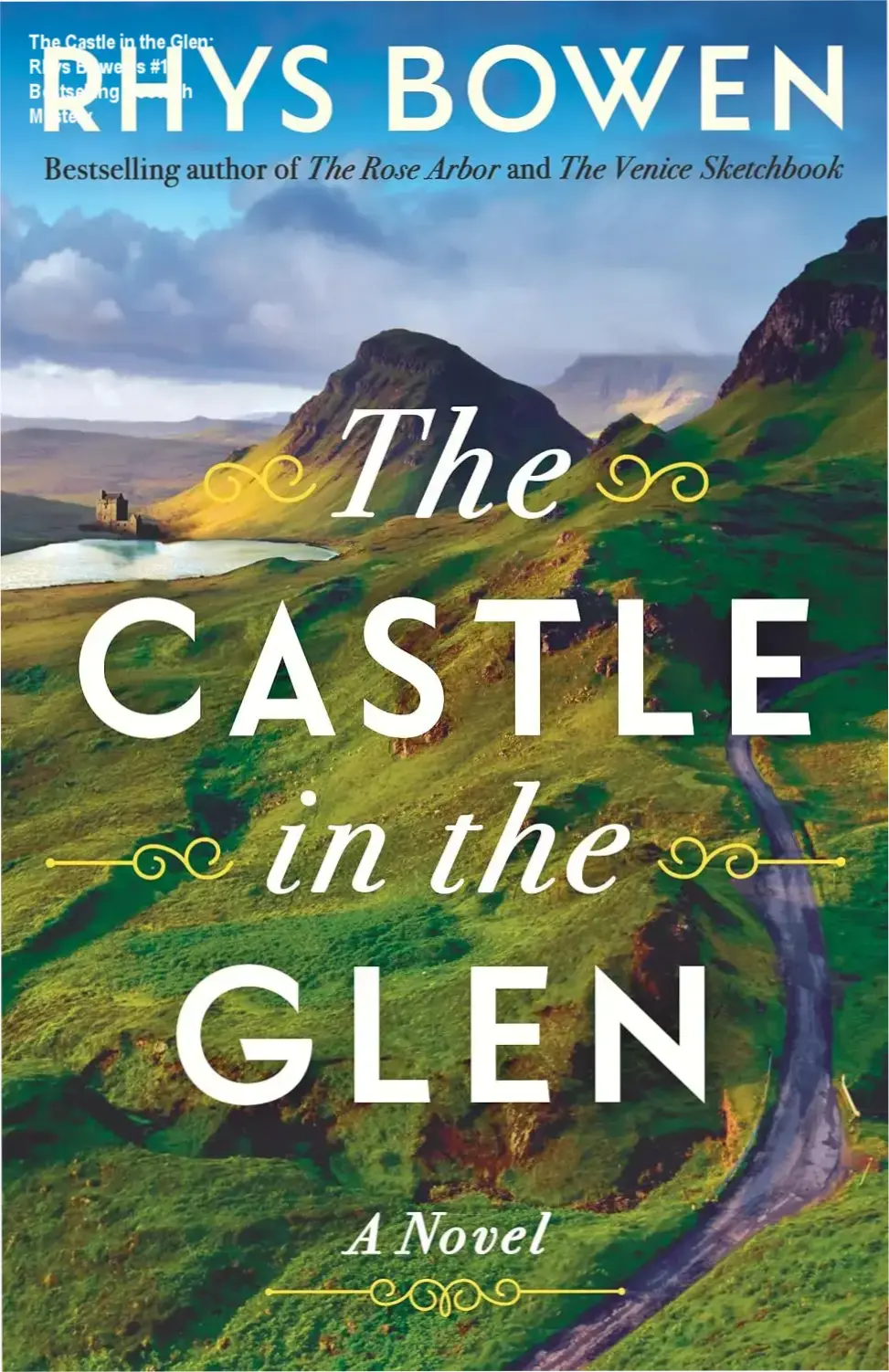
The Castle in the Glen: Rhys Bowen’s #1 Bestselling Scottish Mystery
Historical mystery fans often face a specific frustration: the “cozy” label that promises low stakes and high tea, but delivers a plot so thin it dissolves in the rain. Rhys Bowen has built a career defying that expectation, layering genuine forensic detail under period charm. Her latest standalone pushes further, blending a dual-timeline structure with a meta-fictional twist— a ghostwriter realizing her subject’s “fiction” is actually a cold case. It is a high-wire act. If the 1904 timeline feels like a gothic novel and the 1965 timeline reads like a spy thriller, the bridge between them needs to hold weight.
The premise hooks you immediately. Emma Callander isn’t just a sleuth; she is a professional wordsmith hired to finish a dying legend’s work. That professional vulnerability—imposter syndrome meeting real danger—grounds the atmospheric Scottish setting. The Isle of Skye isn’t backdrop wallpaper here; the mist, the tides, and the clan loyalties function as characters. Early reader sentiment on Goodreads highlights the “Wild Girl” legend as the anchor. It transforms a standard whodunit into a question of historical erasure. Who decides which stories get buried? That question resonates well beyond the genre.
Ready to dive into “The Castle in the Glen: A Novel”?
Explore available editions, check current live pricing, or download a free sample directly on Amazon.
Preview Free Sample & Check Price on Amazon
*You will be redirected to Amazon. As an Amazon Associate, we may earn from qualifying purchases.
Writing Style & Pacing: Controlled Combustion
Bowen writes with a journalist’s economy. There is no fat on these 424 pages. The prose is clean, favoring strong verbs over adjective stacks. You feel the damp cold of the castle stone without a paragraph of weather description. The pacing operates on a slow-burn fuse. The first act establishes the 1965 frame—Emma’s arrival, Iris’s fading mind, the lawyer Tony Gordon’s guarded charm. It feels deliberate. Some readers on Amazon noted the first hundred pages “take their time.” They do. But that time buys credibility for the explosion in act two.
The dual timeline mechanics are seamless. Chapter breaks shift between Emma’s investigation and the 1904 narrative Iris “invented.” The transitions are signposted clearly, avoiding the confusion that plagues lesser dual-timeline novels. The 1904 sections carry a distinct voice—darker, more superstitious, steeped in Gaelic rhythm. The 1965 sections are sharper, modern, procedural. Bowen trusts the reader to synthesize the clues. She doesn’t italicize the past. She lets the detail work speak.
Dialogue is a standout. Tony and Emma banter with the rhythm of a 1940s screwball comedy, but the subtext is all 1960s gender politics and class anxiety. Iris’s fragmented dictation scenes are heartbreaking without being maudlin. Bowen captures the specific horror of a writer losing her vocabulary. It adds a layer of meta-commentary on authorship and memory that elevates the book above standard genre fare.
Narrative Structure: The Architecture of Secrets
The structure is the book’s engine. It is not merely “past and present.” It is a story *about* stories. The central conceit—Iris Blackburn’s final manuscript *is* the historical record—creates a recursive puzzle. Emma isn’t just solving a murder; she is editing a manuscript in real-time, realizing the “plot holes” are actually covered-up evidence. This is catnip for writers and editors. It turns the act of reading into an act of detection.
The “Wild Girl” mystery from 1904 operates on three levels. Level one: the locked-room drowning. Level two: the identity of the girl herself—feral child? Noble bastard? Spy? Level three: why the Macdonald clan (fictionalized but rooted in real clan dynamics) has suppressed it for sixty years. The resolution requires all three threads to pull tight simultaneously. Bowen executes this with a watchmaker’s precision. The final twist—referenced in the blurb as “one not even Emma could have seen coming”—recontextualizes the romance subplot entirely. It reframes Tony’s motivation. It is earned, not cheap.
Reddit threads in r/historicalmystery and r/RhysBowen praise the “fair play” clueing. One user noted: “I flipped back to page 40 after the reveal. The clue was there. It was *always
Target Reader & Value Analysis
Who is this actually for?
If you gravitate toward “atmospheric” mysteries where the setting acts as a character, this is your territory. It is tailor-made for readers who enjoy the dual-timeline structure—switching between the 1960s and the early 1900s—and those who appreciate the “amateur sleuth” trope where intellectual curiosity outweighs police procedure.
Who should probably SKIP this book?
Avoid this if you are looking for a hard-boiled crime thriller or a fast-paced police procedural. If you find “slow-burn” narratives frustrating or dislike the “ghostwriter” plot device, the pacing may feel sluggish. This is a study of secrets and social hierarchies, not a high-octane chase.
Common Purchasing Missteps
Don’t mistake this for a non-fiction account of Scottish history or a technical guide on literary ghostwriting. While the research is evident, it remains a work of fiction. Expect a romanticized, misty version of the Highlands rather than a gritty, realistic portrayal of 1904 rural life.
Quick Contextual FAQ
- Is it a standalone? While it features a series-ending project for the fictional Iris Blackburn, it functions as a self-contained mystery.
- Is the romance central? It is a subplot. The chemistry between Emma and Tony provides the emotional anchor, but the “Wild Girl” mystery drives the plot.
- How is the pacing? Methodical. It rewards patience and attention to detail over sudden shocks.
Editorial Conclusion
Rhys Bowen delivers a polished, sophisticated mystery that succeeds because it doesn’t try to be something it isn’t. It is a “comfort read” with a dark edge. The value lies in the immersive escapism—transporting the reader from the 1960s to a medieval castle with ease. While the twist is designed to be “fiendish,” experienced mystery readers might spot the breadcrumbs early, but the journey remains satisfying.
For those who value atmospheric storytelling over raw speed, this is a high-value addition to your library. You can verify the latest reader sentiment and check live discounts on Amazon to see if it fits your current budget.
Final Editorial Verdict
“The Castle in the Glen: A Novel” delivers on its core promise for its intended audience, offering compelling insights without fluff. As highlighted in our detailed edition breakdown, its practical depth and readability are its greatest strengths.
We also recommend checking the official Kindle sample and reader ratings before making your final purchase decision.
*You will be redirected to Amazon. As an Amazon Associate, we earn from qualifying purchases.