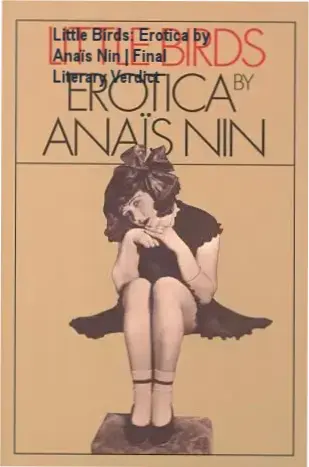
Little Birds: Erotica by Anaïs Nin | Final Literary Verdict
Most erotica is a technical manual. It focuses on the mechanics of the act, the anatomy of the encounter, and a predictable progression toward a climax. For the reader seeking something deeper, this clinical approach often feels hollow. There is a persistent gap in the market for narratives that treat desire not as a destination, but as a psychological landscape—a place where taboo and longing intersect with genuine human complexity.
Anaïs Nin stepped into this void decades ago, and Little Birds: Erotica remains a provocative answer to that craving for intellectual sensuality. Rather than relying on explicit checklists, Nin explores the “why” behind the “what,” making her work a benchmark for the female gaze in erotic literature. If you are tired of formulaic tropes and want to see how desire is mapped through prose, you can check the current reader reception and availability of this collection to see if it aligns with your taste.
Ready to dive into “Little Birds: Erotica”?
Explore available editions, check current live pricing, or download a free sample directly on Amazon.
Preview Free Sample & Check Price on Amazon
*You will be redirected to Amazon. As an Amazon Associate, we may earn from qualifying purchases.
The Architecture of Desire: Writing Style & Pacing
Nin does not write stories; she writes vignettes. Little Birds is composed of thirteen short pieces that feel more like paintings than plots. The pacing is deliberately slow, focusing on the tension of the “almost” rather than the release of the “now.”
Her prose is lush, almost decadent. She uses adjectives like a painter uses colors, layering sensations of scent, touch, and sound to build an atmosphere of intimacy. For some, this is a masterclass in sensuality. For others, it can feel overly ornamental.
The brevity of the pieces is a strategic choice. By stripping away the need for extensive character arcs, Nin forces the reader to focus on the immediate emotional state of the protagonists. It is a concentrated dose of longing.
“It is so distinct an advance in the depiction of female sensuality that I felt, on reading it, enormous gratitude.” — Alice Walker
The “Female Gaze” vs. Market Expectations
There is a common misconception that erotic literature must be “explicit” to be effective. Nin challenges this by prioritizing the psychological internal monologue over the physical external action.
In Little Birds, the focus is on the power dynamics and the emotional stakes of the encounter. Whether it is a French painter or a wanderer in New Orleans, the characters are driven by a need for validation, discovery, or liberation.
This is where the “female gaze” manifests. It is not just about who is being looked at, but how the desire is felt. Nin captures the nuance of female arousal—the mental preparation, the hesitation, and the ultimate surrender to taboo.
| Feature | Standard Erotica | Little Birds (Nin) |
|---|---|---|
| Primary Focus | Physical Act | Psychological Tension |
| Pacing | Linear / Goal-oriented | Atmospheric / Vignette-style |
| Language | Direct / Functional | Poetic / Evocative |
Expectation vs. Reality: The Skeptic’s View
If you go into this book expecting a modern “romance novel” or a fast-paced erotic thriller, you will be
Who Is This Book Actually For?
This is not “beach read” erotica. It is a curated collection for readers who prioritize the psychology of desire over the mechanics of the act.
If you appreciate the “female gaze”—where sensuality is filtered through emotion, atmosphere, and the tension of the taboo—this is your territory.
It appeals specifically to those who enjoy literary vignettes. It’s for the reader who prefers a vivid, poetic sketch of a moment rather than a 400-page narrative arc.
Who Should Skip Little Birds?
Avoid this book if you are looking for a linear plot or a cohesive story. These are fragmented glimpses into different lives, not a novel.
If your definition of erotica is explicit, fast-paced “smut” devoid of poetic fluff, Anaïs Nin’s prose will feel sluggish or overly abstract.
Skeptics of surrealist descriptions or those who prefer clinical, direct language will likely find the imagery too hazy or pretentious.
Value Proposition & Common Purchasing Missteps
At 164 pages, the “value” here isn’t found in the volume of content, but in the density of the prose. You aren’t buying a story; you are buying a mood.
The most common mistake is expecting a modern romance novel. This is mid-century literary exploration. It focuses on the yearning and the internal landscape of the characters rather than a “happily ever after” resolution.
Editorial Conclusion
Little Birds remains a masterclass in evocative writing. It manages to illuminate the darker, more covetous corners of human sexuality without feeling opportunistic.
It is a lean, potent dose of sensuality that challenges the reader to look at desire as an art form. If you are curious about how this translates to a modern reading experience, you can check the latest reader ratings and live discounts here.
Final Editorial Verdict
“Little Birds: Erotica” delivers on its core promise for its intended audience, offering compelling insights without fluff. As highlighted in our detailed edition breakdown, its practical depth and readability are its greatest strengths.
We also recommend checking the official Kindle sample and reader ratings before making your final purchase decision.
*You will be redirected to Amazon. As an Amazon Associate, we earn from qualifying purchases.