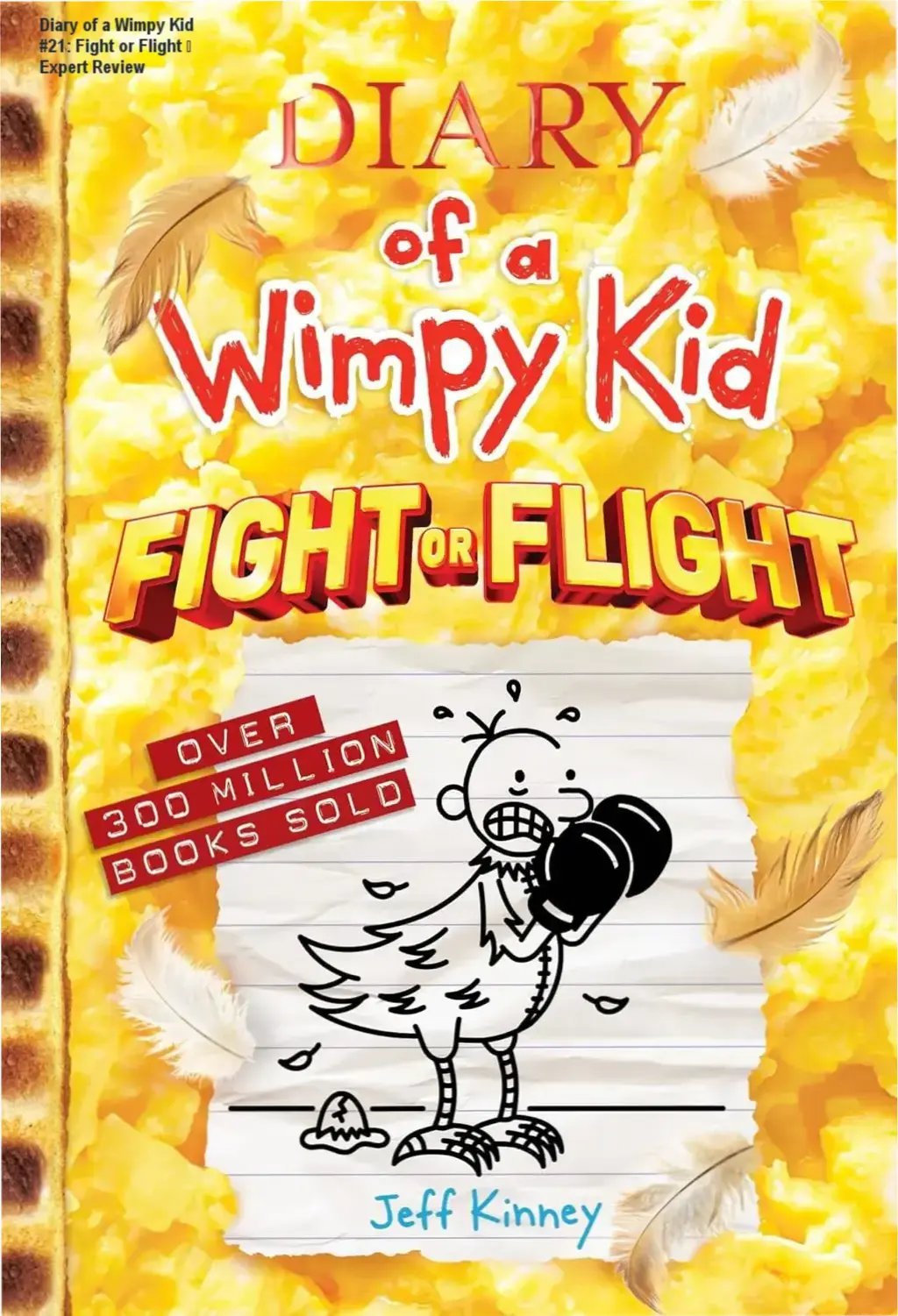
Diary of a Wimpy Kid #21: Fight or Flight – Expert Review
Middle school hasn’t gotten any easier since we were kids. The social minefields have just migrated to group chats and Discord servers, but the core anxiety — the desperate need to survive the lunchroom hierarchy — remains perfectly preserved in amber. Jeff Kinney has built a twenty-one book empire on this exact premise: that the gap between how Greg Heffley sees himself and how the world actually sees him is where the humor lives. It is a formula that refuses to die, largely because the source material — human awkwardness — is an infinite resource.
By volume twenty-one, Diary of a Wimpy Kid isn’t just a series; it is a cultural benchmark for reluctant readers. Parents buy these books not for literary merit, but because they are the only things that get a screen-addicted nine-year-old to voluntarily turn pages. The stakes in Fight or Flight revolve around a “secret binder” of bully intelligence falling into the wrong hands, a classic farce setup that promises the usual cascade of catastrophic misunderstandings. You can check the current edition details and reader reception right here to see if the formula still holds water after two decades.
Ready to dive into “Fight or Flight (Diary of a Wimpy Kid #21)”?
Explore available editions, check current live pricing, or download a free sample directly on Amazon.
Preview Free Sample & Check Price on Amazon
*You will be redirected to Amazon. As an Amazon Associate, we may earn from qualifying purchases.
Writing Style: The Deceptive Simplicity of the “Anti-Diary”
Kinney’s genius is structural. He writes a “diary” that reads nothing like a real kid’s journal. Real diaries are boring, repetitive, and emotionally opaque. Greg’s journal is a tightly plotted sitcom script disguised as chicken scratch handwriting.
The prose remains ruthlessly economical. Sentences are short. Chapters are vignettes. The “handwritten” font forces a reading pace that feels faster than it is. This is a critical design choice for the target demographic. It gamifies literacy. A kid sees 224 pages but reads it in forty minutes because the visual density is low and the payoff frequency is high.
However, the “laugh-out-loud” claim on the cover is marketing speak. The humor is drier than early volumes. It relies heavily on dramatic irony — we know Greg is delusional; he does not. The comedy comes from the cringe, not the punchline. If you are an adult reading this aloud, the jokes land differently. They land on the recognition of parental exhaustion.
Reddit threads on r/books and r/Parenting frequently note a shift in tone around book 15. The “cartoon logic” has hardened into something slightly more cynical. Greg isn’t just unlucky anymore; he is often the architect of his own misery in a way that feels less like slapstick and more like character study. Whether that is growth or stagnation depends entirely on the reader’s age.
Narrative Structure: The Binder MacGuffin
The central plot device — the “Bully Binder” — is a classic Chekhov’s Gun. Greg compiles intelligence on the school’s power players to navigate the social food chain. Losing it isn’t just embarrassing; it is an existential threat to his survival strategy.
This allows Kinney to do what he does best: escalate. Every chapter introduces a new variable. A substitute teacher. A field trip. A misunderstanding with Rowley. The binder passes hands like a hot potato. The pacing is relentless. There is zero fat on the bone.
But the ending — without spoiling — reverts to status quo aggressively. Greg learns nothing. He retains no growth. This is the series’ immutable law. For a twenty-first installment, that rigidity frustrates adult critics but comforts the core audience. Kids don’t want character arcs; they want a reliable universe where the weird kid stays weird and the bullies stay vague threats.
| Spec | Detail |
|---|---|
| Print Length | 224 pages |
| Reading Age | 8 – 12 years |
| Grade Level | 3 – 7 |
| Lexile / Complexity | ~1000L (High interest, low complexity) |
| Illustration Ratio | ~50/50 Text to Image |
This book targets the 8–12 demographic precisely, but the sweet spot sits closer to ages 9–11. Kids transitioning from early chapter books to heavier middle-grade novels find the hybrid text/illustration format a perfect bridge. Reluctant readers gravitate toward the visual breaks; voracious readers consume it in one sitting for the comfort factor. Parents buying for classroom libraries or birthday gifts hit a safe bullseye here—low risk, high engagement. If your reader has aged out of the “middle school anxiety” phase—think high school freshmen or sophisticated 12-year-olds craving complex narratives—this feels repetitive. The formula hasn’t shifted in two decades: Greg schemes, Greg fails, Greg learns a vague lesson. Readers seeking character growth arcs or serialized consequences across books will be frustrated. The status quo is the product. Is it harder or easier than previous entries? Lexile level sits consistent at ~950L. Vocabulary hasn’t scaled up. Any sensitive content? Standard sibling cruelty (Rodrick), mild bullying, zero profanity. Safe for conservative households. Collectible value? First-edition hardcovers hold modest resale if kept pristine, but mass print runs limit upside. Fight or Flight delivers exactly what the SKU promises: 224 pages of reliable, illustrated comfort food. It won’t convert skeptics, but it retains the fanbase. The “secret binder” hook offers a slightly tighter plot engine than recent meandering entries (Hot Mess, Partypooper), making this a top-half series entry. Value-for-money hinges entirely on format choice—hardcover at launch price is fair; wait for paperback if budget is tight. You can verify current discounts and reader sentiment here. “Fight or Flight (Diary of a Wimpy Kid #21): A laugh-out-loud knockout from the #1 international bestselling Diary of a Wimpy Kid series (Volume 21)” delivers on its core promise for its intended audience, offering compelling insights without fluff. As highlighted in our detailed edition breakdown, its practical depth and readability are its greatest strengths. We also recommend checking the official Kindle sample and reader ratings before making your final purchase decision. *You will be redirected to Amazon. As an Amazon Associate, we earn from qualifying purchases.Who Should Skip It
Common Purchasing Missteps
Contextual FAQ
Editorial Summary
Final Editorial Verdict