
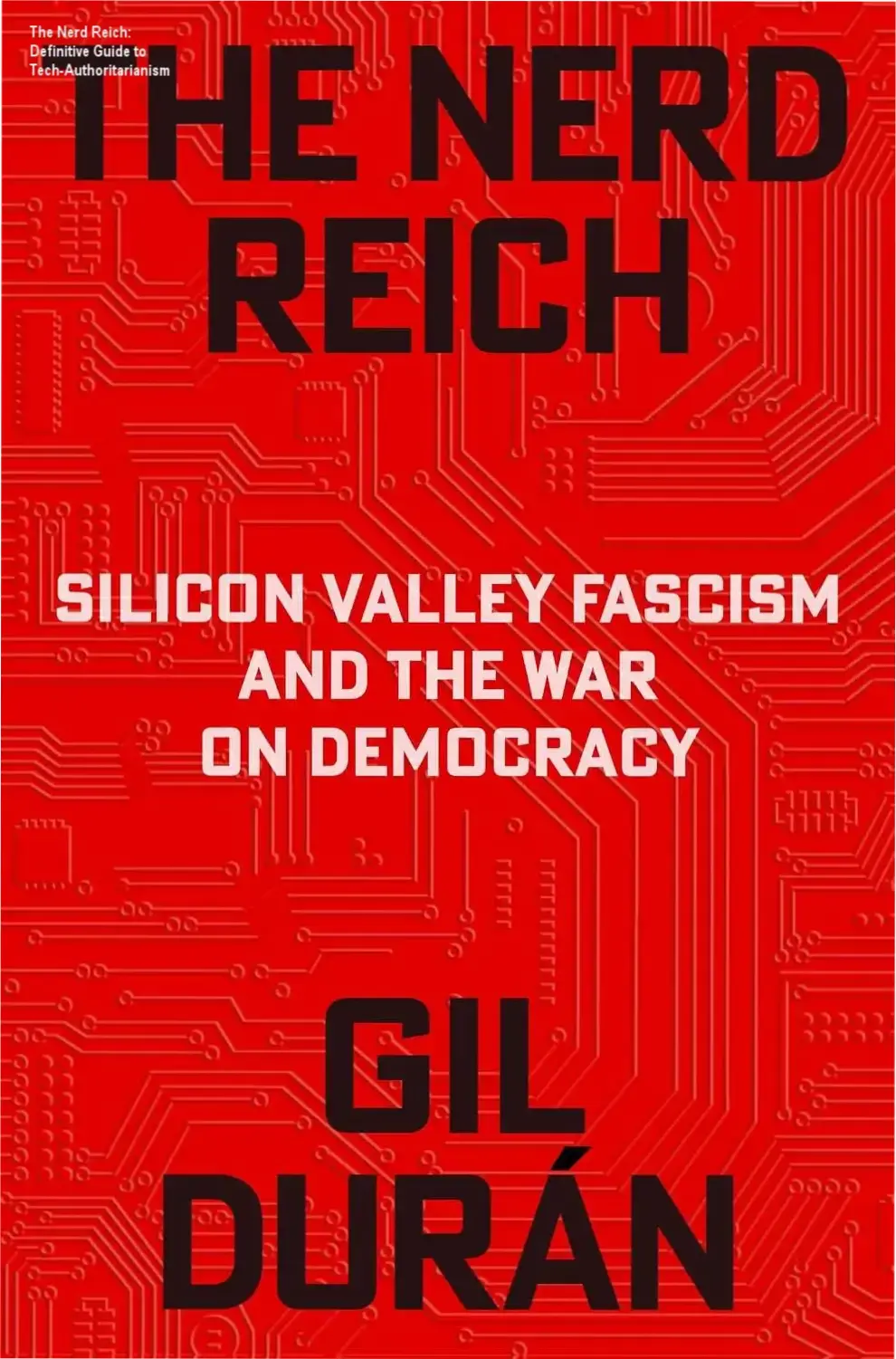
The Nerd Reich: Definitive Guide to Tech-Authoritarianism
Most of us grew up believing that “disruption” was just a business buzzword. We were told that when a startup “moves fast and breaks things,” it’s simply the price of progress—a necessary chaos to bring us better apps and faster deliveries.
But there is a darker side to this narrative. For those paying attention, the pattern isn’t about efficiency; it’s about power. The transition from a democratic society to one managed by algorithmic decree is happening in plain sight, often disguised as “innovation.” You can see the growing anxiety and anticipation for this analysis by checking the current reader reception and availability of the book.
Gil Durán’s “The Nerd Reich” doesn’t treat Silicon Valley as a hub of genius, but as a breeding ground for a new kind of authoritarianism. It challenges the reader to stop looking at tech billionaires as eccentric visionaries and start seeing them as political architects attempting to dismantle the state to replace it with corporate rule.
Ready to dive into “The Nerd Reich”?
Explore available editions, check current live pricing, or download a free sample directly on Amazon.
Preview Free Sample & Check Price on Amazon
*You will be redirected to Amazon. As an Amazon Associate, we may earn from qualifying purchases.
The “Disruption” Delusion and the Architecture of Control
Durán begins by stripping away the glossy veneer of the “tech bro” persona. He argues that the ethos of Silicon Valley isn’t actually about liberation, but about the removal of friction—where “friction” is defined as any law, regulation, or democratic process that slows down capital.
The book posits that the ultimate goal isn’t to improve the existing system, but to render it obsolete. When billionaires talk about “building cities from scratch” or “network states,” they aren’t dreaming of utopia. They are designing exits from the social contract.
This is where the “Nerd Reich” concept enters. It’s not a traditional fascist movement with boots on the ground, but a digital one. It’s a movement that uses code, cryptocurrency, and AI to create a hierarchy where the owners of the platform hold all the legislative power.
The Philosophical Blueprint: From “Sovereign Individuals” to Digital Feudalism
One of the strongest parts of the book is the deep dive into the intellectual roots of this movement. Durán points to “The Sovereign Individual” as the “bible” for the modern tech elite.
This philosophy suggests that the nation-state is a legacy system. In its place, the authors envisioned a world where high-net-worth individuals operate above the law, using technology to shield their wealth and influence.
Durán shows how this transitioned from a fringe theory to a practical roadmap. He connects the dots between the early days of San Francisco politics and the current influence of these figures in the highest levels of government.
“Democracy is being dismantled not by coups or tanks, but by code, capital, and the illusion of innovation.”
This quote encapsulates the book’s core thesis. The “coup” is invisible because it happens in the Terms of Service updates and the algorithmic curation of our reality.
The Apostles of the New Order: Thiel, Musk, and Andreessen
The book doesn’t just talk in abstractions; it names names. Durán analyzes the specific roles played by Peter Thiel, Marc Andreessen, Balaji Srinivasan, and Elon Musk.
He presents them not as random allies, but as a cohesive group with a shared goal: the replacement of elected governments with corporate rule. Each brings a different tool to the table—Thiel the strategy, Musk the megaphone, and Andreessen the venture capital.
The analysis of Elon Musk is particularly biting. Durán frames the acquisition of social media platforms not as a quest for “free speech,” but as the acquisition of a psychological operations tool to steer public discourse toward authoritarian ends.
| The Technocrat’s Goal | The Public Narrative | The Analytical Reality |
|---|---|---|
| Network States | Who This Book Is Actually For This isn’t a casual read for the tech-curious. It’s designed for the analytical skeptic. If you track the intersection of venture capital and political power, this is your roadmap. It’s for those who suspect that “disruption” is often a euphemism for dismantling public institutions. Skip this book if:
The Value Proposition: Analysis vs. NoiseMany books touch on “Big Tech.” Most are surface-level complaints about privacy or screen time. Durán goes deeper. The value here lies in the connective tissue. He links the 1990s philosophy of The Sovereign Individual to today’s “network states” and digital feudalism. At 352 pages, it’s a dense investigation. You aren’t paying for a summary of news cycles; you’re paying for a systemic autopsy of an ideology. Common Purchasing MisstepsThe biggest mistake readers make is expecting a “how-to” guide or a quick polemic. This is a narrative investigation. It requires patience. It’s not a listicle of “10 things Elon Musk did wrong.” It’s a study of how code, capital, and algorithmic propaganda are being weaponized to replace elected governments. Editorial VerdictThe Nerd Reich is an ominous, necessary read. It strips away the “innovation” facade to reveal a calculated campaign for corporate rule. While the tone is urgent—bordering on alarmist—the evidence is grounded in political reality. It doesn’t offer an easy fix, but it provides the intellectual tools to recognize the pattern. For those wanting to see if the current political climate matches the data, we suggest checking recent reader reviews and current pricing to see if the thesis resonates with other analysts. Final Editorial Verdict“The Nerd Reich: Silicon Valley Fascism and the War on Democracy” delivers on its core promise for its intended audience, offering compelling insights without fluff. As highlighted in our detailed edition breakdown, its practical depth and readability are its greatest strengths. We also recommend checking the official Kindle sample and reader ratings before making your final purchase decision. Relacionado Posts Similares
|