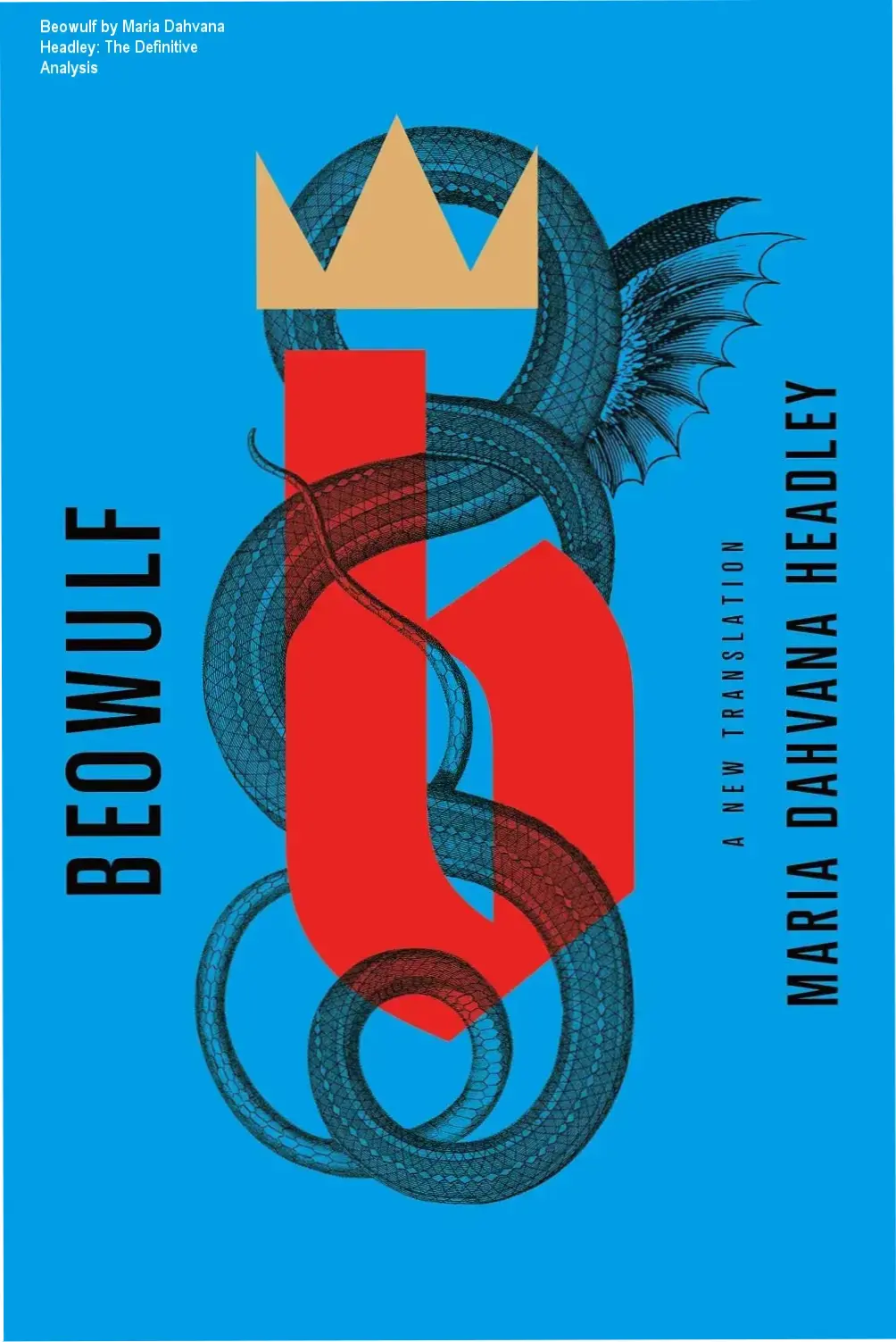
Beowulf by Maria Dahvana Headley: The Definitive Analysis
Most of us remember Beowulf as a chore. It was that dusty, incomprehensible poem forced upon us in high school, filled with archaic words and a narrative that felt as distant as the glaciers of the Ice Age. For decades, the “classic” translations focused on the nobility of the warrior and the terror of the beast, reinforcing a rigid, masculine epic that felt more like a museum piece than a living story.
But the problem isn’t the story; it’s the lens. When we strip away the “thees” and “thous,” we find a tale of toxic masculinity, territorial disputes, and the desperate cry for justice. Maria Dahvana Headley decides to stop pretending this is a polite piece of literature. You can check the current reception of this translation on Amazon to see how a feminist, contemporary approach has completely disrupted the academic status quo.
Ready to dive into “Beowulf: A New Translation”?
Explore available editions, check current live pricing, or download a free sample directly on Amazon.
Preview Free Sample & Check Price on Amazon
*You will be redirected to Amazon. As an Amazon Associate, we may earn from qualifying purchases.
The “Brash” Writing Style: Slang in the Mead Hall
Headley doesn’t just translate words; she translates vibes. The most jarring—and exhilarating—part of this edition is the language. She mixes sublime poetry with obscenities and social-media shorthand.
To a purist, this is heresy. To a modern reader, it’s a revelation. The original Old English was visceral, boastful, and often crude. By using contemporary language, Headley recaptures the actual energy of the original oral tradition, which was meant to entertain a crowd, not put them to sleep in a lecture hall.
The pacing is aggressive. It moves with the speed of a modern thriller. You aren’t wading through thickets of adjectives; you are being hit with direct, punchy lines that expose the ego of the characters.
“Brash and belligerent, lunatic and invigorating, with passages of sublime poetry punctuated by obscenities and social-media shorthand.” — Ruth Franklin, The New Yorker
Recontextualizing the Monster: A Feminist Lens
The core of this translation is the shift in perspective. In traditional versions, Grendel is a mindless beast and Beowulf is a flawless hero. Headley flips the script.
She highlights the “entitlement” of the powerful men in the story. Beowulf isn’t just saving the day; he’s building a brand. He is the ultimate “alpha” in a world that rewards violence and noise.
Then there is Grendel. In this version, the monster’s desire for silence in his own territory feels less like evil and more like a reaction to the oppressive noise of the mead hall. The binary of “hero vs. monster” blurs, suggesting that the real monsters are often the ones wearing the crowns.
The role of women is also brought to the forefront. Instead of being mere prizes or passive observers, the women in this version possess a sharp, often tragic, agency. The warrior seeking to avenge her son becomes a pivotal emotional anchor, rather than a footnote.
The Great Divide: Amazon vs. Goodreads
If you look at the data, there is a fascinating split in how this book is perceived. On Amazon, it boasts a high 4.6 rating. On Goodreads, it sits around 3.5.
This is a classic case of “Expectation vs. Reality.” The Amazon crowd tends to appreciate the boldness and the accessibility. They love that a 1,000-year-old poem finally feels like it was written in the 21st century.
The Goodreads crowd, often populated by literary scholars and “classic” enthusiasts, finds the modernisms distracting. They argue that “social media shorthand” kills the timelessness of the epic.
My take? The “timelessness” of the classics is often a myth used to justify boring translations. Headley’s version is an experiment in emotional accuracy over literal accuracy.
| Perspective | Who Is This Translation Actually For? This is not a book for the literary purist or the academic seeking a sterile, word-for-word reproduction of Old English. If you are looking for the “stuffy” experience of a high school textbook, skip this version. Headley’s translation is designed for a specific profile: the reader who views classics as living documents. It appeals to those who appreciate subversive storytelling, feminist critiques, and the raw, visceral energy of the original oral tradition—which was likely far more “brash” than 19th-century translations ever dared to admit. You should buy this if:
You should avoid this if:
Value Analysis: Investment vs. ReturnAt 178 pages, this is a lean, high-impact volume. The value here isn’t in the quantity of text—since the story of Beowulf is static—but in the interpretive lens. A common purchasing mistake is expecting a “quick manual” or a simplified children’s version. This is a sophisticated piece of literary art. You are paying for Headley’s expertise as a novelist and her willingness to challenge the “hero vs. monster” binary. Is it “accurate”? In a linguistic sense, it’s a translation. In a spiritual sense, it’s a reconstruction. For the price of a Kindle edition or a paperback, the intellectual provocation it provides far outweighs the cost, provided you accept the “belligerent” tone as a feature, not a bug. Editorial ConclusionMaria Dahvana Headley has successfully stripped the “museum dust” off Beowulf. By centering the narrative on entitlement, encroachment, and the silenced voices of women, she transforms a tale of monster-slaying into a mirror of modern power struggles. It is a polarizing work. You will either find it invigoratingly honest or irritatingly anachronistic. However, in a market saturated with “safe” translations, this is the first version in decades that actually feels dangerous. To see how other readers reacted to this radical shift in tone, we suggest checking the verified buyer reviews on Amazon. Final Editorial Verdict“Beowulf: A New Translation” delivers on its core promise for its intended audience, offering compelling insights without fluff. As highlighted in our detailed edition breakdown, its practical depth and readability are its greatest strengths. We also recommend checking the official Kindle sample and reader ratings before making your final purchase decision. *You will be redirected to Amazon. As an Amazon Associate, we earn from qualifying purchases. Posts Similares
|
|---|