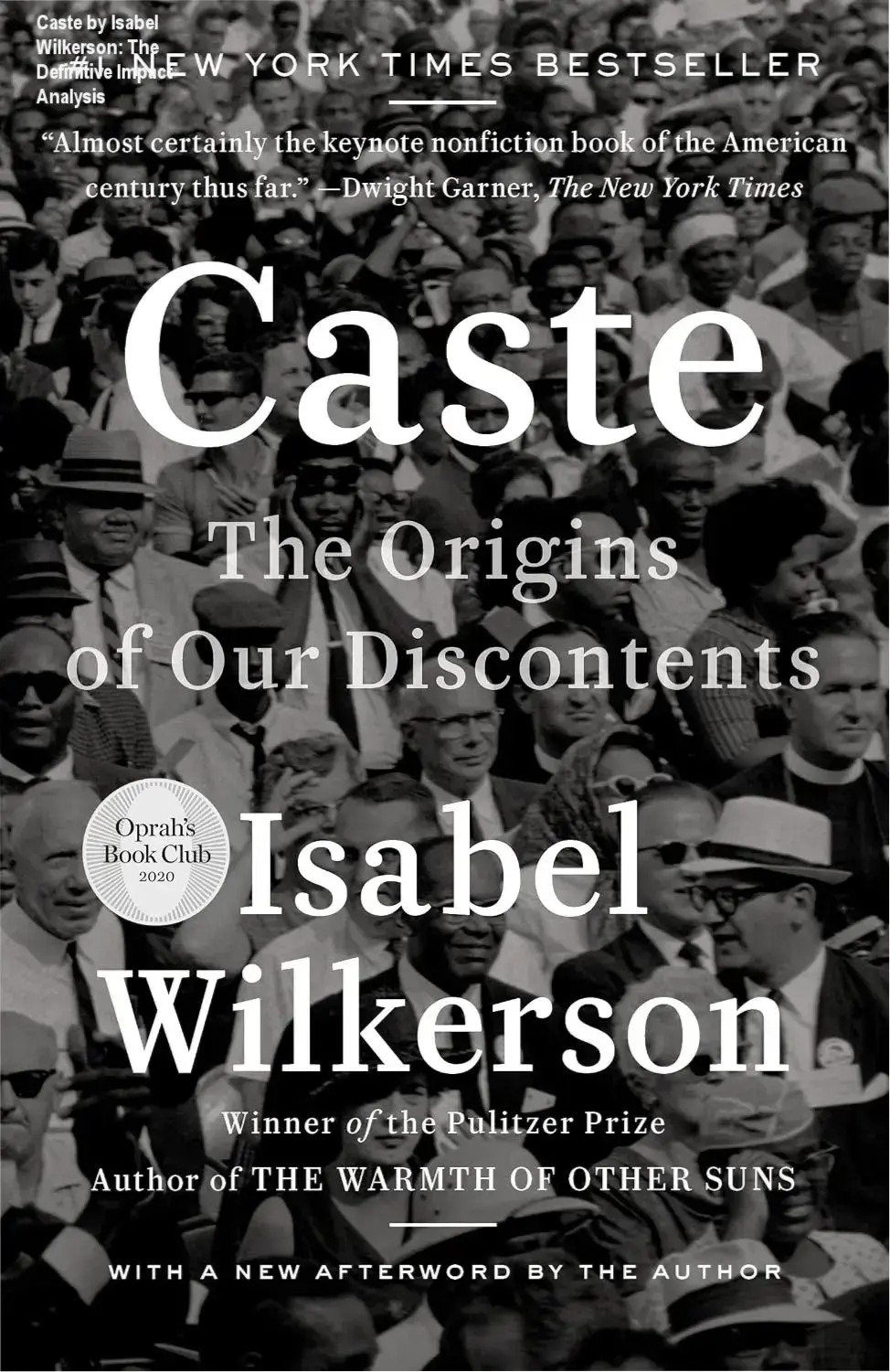
Caste by Isabel Wilkerson: The Definitive Impact Analysis
We often talk about racism as a personal failing or a systemic glitch. We treat it as a matter of hate, prejudice, or a lack of education. But what if the problem isn’t actually about race? What if race is simply the visible skin draped over a much older, more rigid skeleton called caste?
Most readers approach this subject expecting a standard sociology textbook. They expect dry data and academic jargon. Instead, they find a narrative that feels more like a forensic investigation into the human soul. You can explore the global impact of this thesis and see the current reader ratings by visiting the official Amazon page.
Ready to dive into “Caste: The Origins of Our Discontents”?
Explore available editions, check current live pricing, or download a free sample directly on Amazon.
Preview Free Sample & Check Price on Amazon
*You will be redirected to Amazon. As an Amazon Associate, we may earn from qualifying purchases.
The Skeleton vs. The Skin: The Core Argument
Isabel Wilkerson doesn’t just write a book; she proposes a paradigm shift. Her central thesis is that the United States is not a racial democracy with a “race problem,” but a caste society.
For the skeptical reader, this sounds like a semantic game. Why change the word? Because “race” implies a biological difference. “Caste” implies a structural hierarchy.
Wilkerson argues that race was the tool used to create the caste system, but the system itself is the engine. It is the “wordless usher” that tells you where to sit in the theater of society before you even enter the room.
This distinction is crucial. If the problem is race, you solve it with tolerance. If the problem is caste, you solve it by dismantling the entire architecture of power.
The book is dense, but the logic is surgical. She strips away the emotional noise of political discourse to reveal the mechanical pillars that hold these hierarchies in place.
| Feature | Details |
|---|---|
| Core Thesis | Race is the visible marker; Caste is the invisible structural hierarchy. |
| Comparative Scope | USA, India, and Nazi Germany. |
| Key Metric | Focus on power dynamics rather than individual morality. |
| Reading Length | 649 pages (Comprehensive and immersive). |
The Global Mirror: India and Nazi Germany
One of the most daring moves Wilkerson makes is linking the American experience to the Dalit system in India and the racial laws of Nazi Germany.
At first glance, these seem like disparate tragedies. However, she identifies “eight pillars” of caste that are universal across these civilizations.
These include divine will, bloodlines, and the creation of “stigma” to keep the lower castes in their place. It is a chilling realization.
By stepping outside the American bubble, she removes the defensive “exceptionalism” that often plagues US sociology. She shows that this is a human pattern, not just an American mistake.
Some critics on Reddit and Goodreads argue that the comparison to Nazi Germany is too aggressive. They feel it oversimplifies the Holocaust to fit a sociological mold.
But from an analytical standpoint, the comparison works. She isn’t equating the scale of death, but the mechanism of dehumanization.
Narrative Pacing and the Journalist’s Touch
Wilkerson is a Pulitzer Prize-winning journalist, and it shows. This is not a dry academic paper. It is a collection of lived experiences.
She weaves in stories of figures like Martin Luther King Jr. and Satchel Paige. She uses these narratives to ground her abstract theories in human flesh and blood.
Who Is This Book Actually For?
This isn’t a casual beach read. Caste is designed for the intellectual explorer—someone who feels that the current vocabulary for discussing race and class is insufficient to explain the systemic rigidity of society.
The ideal reader is someone who appreciates comparative sociology. If you enjoy connecting the dots between disparate historical events—like linking the Jim Crow South to the varna system in India or the racial laws of Nazi Germany—this book will feel like a revelation.
- The Academic: Those seeking a structural framework to understand power dynamics.
- The History Buff: Readers who prefer narrative-driven non-fiction over dry textbooks.
- The Socially Conscious: People looking for a “lens shift” to understand unconscious biases.
The “Skip” List: Who Should Pass on This?
Avoid this book if you are looking for a quick, actionable manual on social justice. This is an analytical deep dive, not a “how-to” guide.
You should likely skip this if you have a low tolerance for long-form narratives. At 649 pages, Wilkerson takes her time. If you prefer concise, bullet-pointed arguments or fast-paced political manifestos, the pacing here may feel sluggish.
Furthermore, if you are looking for a purely statistical report on racial disparity, you’ll be disappointed. Wilkerson focuses on the psychology and architecture of hierarchy, not just the data points.
Value Analysis: Investment vs. Return
From a value-for-money perspective, the ROI is high, provided you have the time to invest. You aren’t paying for new “facts”—most of the historical events are documented—but for a new synthesis of those facts.
The primary risk is the “purchase mistake”: buying the book expecting a lightweight commentary and feeling overwhelmed by the density. However, for those who finish it, the mental framework provided is an asset that lasts a lifetime.
Editorial Verdict
Isabel Wilkerson has managed to create a rare piece of non-fiction that is both academically rigorous and emotionally resonant. While the 600+ page count is daunting, the prose is fluid, and the comparisons are surgically precise.
It doesn’t offer easy answers, but it provides a more accurate map of the problem. If you’re ready to challenge your fundamental understanding of social stratification, it’s a mandatory addition to your library. You can explore the current pricing and read verified buyer experiences via the official Amazon listing.
Final Editorial Verdict
“Caste: The Origins of Our Discontents” delivers on its core promise for its intended audience, offering compelling insights without fluff. As highlighted in our detailed edition breakdown, its practical depth and readability are its greatest strengths.
We also recommend checking the official Kindle sample and reader ratings before making your final purchase decision.
*You will be redirected to Amazon. As an Amazon Associate, we earn from qualifying purchases.