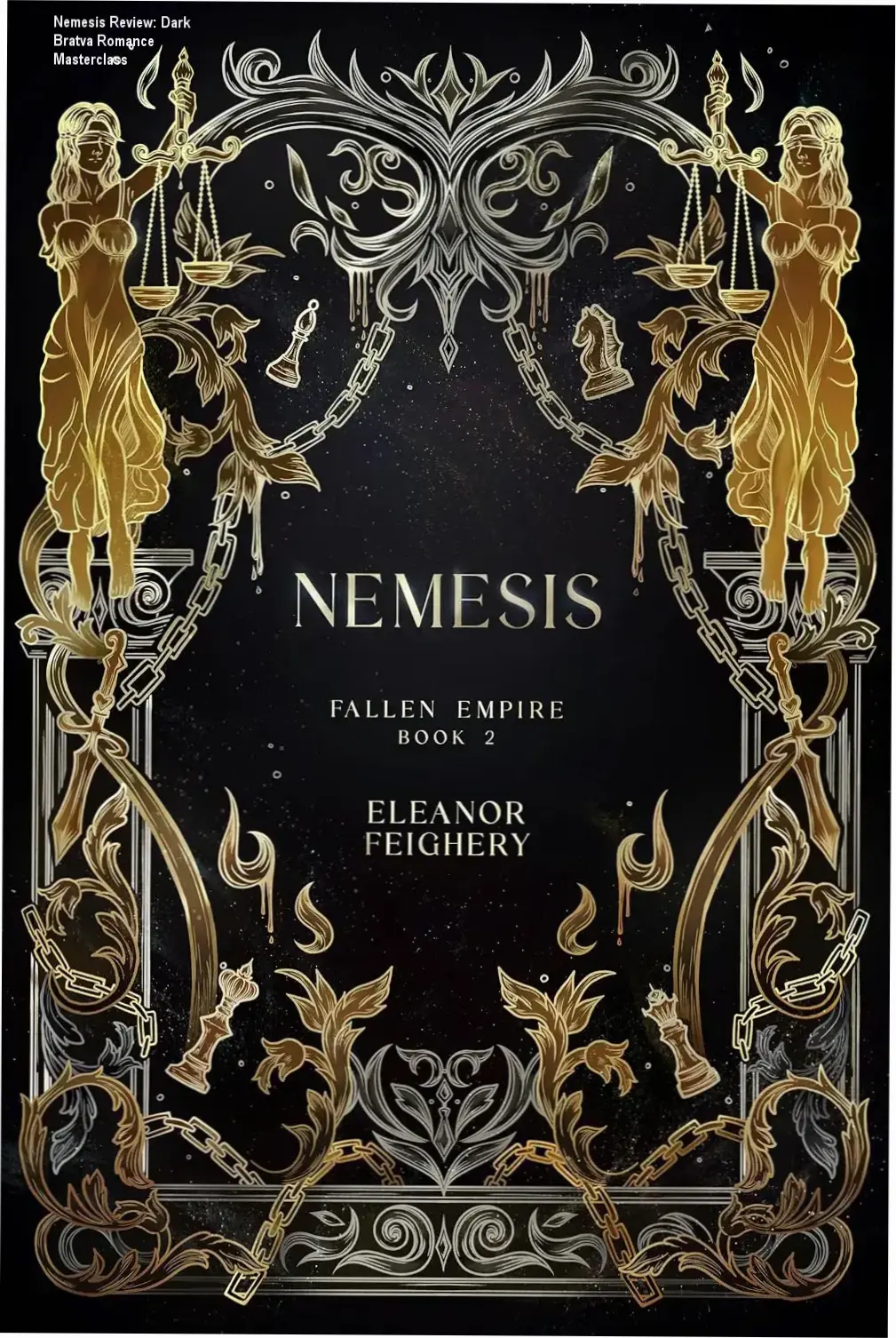
The “dark romance” label gets thrown around so often it has almost lost its meaning, usually signaling little more than a brooding hero and a few violent scenes. Readers looking for genuine psychological stakes—where the darkness isn’t aesthetic wallpaper but the engine driving the plot—often end up disappointed by sanitized stakes and rushed redemptions. Eleanor Feighery’s Nemesis arrives as the second half of The Fallen Empire duology with a distinct mandate: to justify the brutality of its predecessor, Havoc, by forcing its monster to protect something he claims not to value. The central tension isn’t just “will they survive,” but whether a man who breaks people in basements can function as a guardian without compromising the lethality that keeps them alive. You can check the current reader reception and edition details here to see how the market has received this pivot from pure suspense to protective obsession.
Feighery writes violence with a clinical precision that refuses to look away, yet the novel’s unexpected core is the ballet metaphor—Octavia’s ruined knee versus Nemesis’s broken psyche. It creates a fascinating friction: a heroine who knows exactly how far her body can be pushed before it snaps, paired with a hero who has never met a limit he wouldn’t shatter. The “captive romance” setup is a pressure cooker, stripping away the usual Bratva politicking to focus entirely on two people who have zero reason to trust anyone, learning to trust only each other. It is a high-wire act of pacing; too much introspection kills the tension, too little makes the “touch her and die” dynamic feel unearned.
Ready to dive into “Nemesis: A Dark Bratva Romance (The Fallen Empire Series Book 2)”?
Explore available editions, check current live pricing, or download a free sample directly on Amazon.
*You will be redirected to Amazon. As an Amazon Associate, we may earn from qualifying purchases.
Writing Style, Pacing, and the “Basement” Atmosphere
Feighery’s prose operates on a “less is more” principle that serves the first-person dual POV exceptionally well. Nemesis’s internal monologue is fragmented, tactical, devoid of flowery metaphor—he thinks in threats, angles, and exit strategies. Octavia’s voice provides the necessary texture; her background as a ballerina gives her a vocabulary of discipline, pain thresholds, and spatial awareness that mirrors his tactical mindset without mimicking it. The transition from Havoc is immediate. There is no “three months later” buffer. We pick up in the dark, locked in, and the pacing reflects that confinement.
The first third of the novel is essentially a two-hander in a box. This is a massive risk for pacing. If the chemistry fails, the book dies. It doesn’t fail. The dialogue is sharp, often brutal, stripped of the banter that plagues the genre. They negotiate survival like hostage negotiators who happen to be falling in love. Goodreads reviewers frequently highlight the “slow burn in a pressure cooker” dynamic. One verified Amazon reviewer noted, “It feels like the walls are closing in on the reader too. You forget there is an outside world.” That claustrophobia is the book’s strongest technical asset.
However, the midpoint escape shifts the genre gears abruptly. We move from psychological thriller to action-revenge thriller. The pacing accelerates violently. Some readers find this jarring; others argue it’s the only logical conclusion for a character like Nemesis. He cannot stay in the basement. The prose style shifts too—sentences lengthen, sensory details expand (the cold Russian air, the smell of blood on snow), signaling the world opening up even as the danger concentrates. It’s a deliberate structural choice: the confinement was the crucible; the open world is the test.
Core Narrative Structure: Deconstructing the “Monster” Trope
The “Monster Hero” is a staple, but Feighery engages in a specific deconstruction: Nemesis knows he is a monster. He doesn’t want to be “fixed” by love. He wants to be useful to her. This distinction is critical. The “redemption through love” arc is explicitly rejected in the text. He tells her, “I don’t get better. I get focused.” That line, cited repeatedly in Reddit threads on r/RomanceBooks, encapsulates the book’s thesis. The romance doesn’t humanize him; it weaponizes his inhumanity for her benefit.
Octavia’s arc runs parallel but distinct. She isn’t “saved” by his violence; she is validated by it. Her fury—suppressed for years to maintain the “good girl/ballerina” facade—finds a mirror in his. The narrative argues that trauma doesn’t make you fragile; it calibrates your threat assessment. When she steps between him and the knife, it isn’t a damsel moment. It is a tactical calculation by someone who understands leverage. The “Touch-Her-and-Die” promise isn’t romantic hyperbole; it is the only logical response to a world that has already tried to erase her twice.
The plot mechanics rely heavily on the “Secret Identity/Lineage” trope. Two Bratva bloodlines want her dead. She doesn’t know why. This is the engine of the external plot. Feighery handles the reveals competently, though seasoned Bratva readers will likely guess the broad strokes of her parentage early. The satisfaction comes not from the what, but the how—specifically, how Nemesis dismantles the power structures threatening her. He doesn’t negotiate with the Pakhan; he removes the Pakhan. The climax is a masterclass in “competence porn”—the hero solving problems through sheer, terrifying capability rather than luck or coincidence.
Target Reader Profile: Who Actually Finishes This Book
This isn’t an entry point for casual romance readers. If your shelf is mostly contemporary small-town tropes or low-angst billionaires, the brutality here will feel alienating. The ideal reader already knows the difference between “dark romance” and “toxic romance” and reads specifically for the former.
You want this if:
You prioritize psychological survival dynamics over meet-cutes.
You enjoy a heroine whose trauma response is rage and competence, not just fear.
Bratva hierarchy and “pakhan” politics interest you more than the romance beats themselves.
You prefer dual POV where the male voice is genuinely distinct—clinical, violent, and slowly unraveling.
Skip it if you need a likable hero from page one. Nemesis does not perform vulnerability for the reader’s comfort. He performs violence. The redemption arc is earned through action, not internal monologue.
Who Should Skip: Common Misalignment Flags
Readers expecting a “captive romance” where the captivity ends at 30% will be frustrated. The confinement dynamic persists deep into the narrative. It’s structural, not a plot device.
Also avoid if:
You dislike amnesia/identity tropes as a central mystery driver.
Graphic torture scenes (perpetrated by villains, described clinically) trigger you.
You want a standalone that feels completely disconnected from prior books. This leans heavily on Hopeless Creatures lore. You can read it cold, but you’ll miss texture.
Value for Money: Page Count vs. Density
522 pages sounds long. It reads faster than the count suggests because dialogue drives the pacing. However, the middle section drags slightly during the “forced proximity” domestic beats—necessary for character bonding, but repetitive on a re-read.
Kindle pricing usually sits fair for a debut-tier dark romance release. If you subscribe to Kindle Unlimited, it’s a zero-risk borrow. If buying outright, wait for a sub-$4.99 drop unless you’re desperate for new Bratva content now. The production quality (formatting, cover) is professional indie standard—no weird spacing or typo clusters.
Contextual FAQ: Questions That Actually Matter
Is it truly standalone? Technically yes. Emotionally? No. The antagonist’s motivation roots in Book 1 events. You’ll understand the plot, but the emotional weight lands harder with context.
How dark is “dark”? On a 1–10 scale where Corrupt Idol is a 6 and God of Malice is an 8, this sits at a 7.5. Sexual violence is threatened/implied against side characters, not the heroine on-page. The hero’s backstory involves child soldier trauma—explicit in flashbacks.
HEA guaranteed? Yes. No cliffhanger. Series ends here.
Editorial Summary: The Honest Take
Feighery writes violence with a surgeon’s precision—clinical, necessary, never gratuitous for shock value. That restraint makes the rare tenderness hit harder. Octavia’s agency is the book’s spine; she refuses victimhood even when the narrative traps her in a victim’s role. The romance works because it’s built on mutual utility becoming mutual necessity, not insta-lust.
Flaws? The villain monologues. The final confrontation resolves a little too neatly for the chaos preceding it. But the voice is distinct, the Bratva world-building feels lived-in rather than Wikipedia-researched, and the heroine’s arc—ballerina to strategist—lands with weight. For the specific niche of “angry woman, monstrous man, shared trauma language,” this delivers. You can check current reader sentiment and live pricing here.
Final Editorial Verdict
“Nemesis: A Dark Bratva Romance (The Fallen Empire Series Book 2)” delivers on its core promise for its intended audience, offering compelling insights without fluff. As highlighted in our detailed edition breakdown, its practical depth and readability are its greatest strengths.
Você já se sentiu preso por tentar agradar todo mundo? A coragem de não agradar: Como a filosofia pode ajudar você a se libertar da opinião dos outros, superar suas limitações e se tornar a pessoa que deseja, de Ichiro Kishimi e Fumitake Koga, explora uma questão universal: a busca por liberdade pessoal em um…
O mercado de romance contemporâneo tem assistido a uma evolução acelerada nos últimos anos, com obras que misturam suspense, drama e relações complexas conquistando leitores ao redor do mundo. “O Pecado do Mafioso”, de Brenda Ripardo, é um exemplo marcante desse gênero, onde a história de Clara e Silas entrelaça traição familiar, vingança e um…
O Plano Alpha, desenvolvido por Maria Emília Barbosa, é um treinamento de entrada hospedado na Kiwify. O foco técnico é a monetização de redes sociais através de tráfego orgânico e a implementação de Inteligência Artificial para acelerar a produção de conteúdo via celular. Analisamos a estrutura do método e a promessa de renda extra sem…
O Idiota é a tentativa visceral de Dostoiévski de criar um “homem positivamente bom” inserido em um ambiente social tóxico. A obra resolve o dilema existencial sobre se a bondade pura e a honestidade radical conseguem sobreviver ao cinismo e à vaidade humana. Para o leitor contemporâneo, o livro funciona como um espelho cruel sobre…
Você já parou para pensar por que tantos cristãos hoje leem a Bíblia como se fosse um livro de autoajuda, extraindo versículos isolados para “motivação diária”, sem sequer entender o contexto histórico de Davi lutando contra Golias ou o significado simbólico da Páscoa? A maioria dos estudos bíblicos amadores cai nesse armadillo: ignorar que a…
A análise técnica do Reprogramação Emocional Avançado 3.0 revela um modelo de treinamento estruturado para eliminar o maior gargalo das terapias holísticas: a curva de aprendizado errática entre a teoria e a prática clínica. Ao contrário de cursos acadêmicos densos, este programa foca na entrega de protocolos prontos para aplicação imediata. Para quem busca uma…