Most people view their hometown as a starting point, but for many, it feels more like a perimeter. There is a specific, suffocating kind of gravity that pulls at those born into isolated communities where tradition, faith, and economic hardship are woven into the same cloth. When your identity is predefined by your ancestors and your local church, the act of wanting “more” can feel like a betrayal of your own blood.
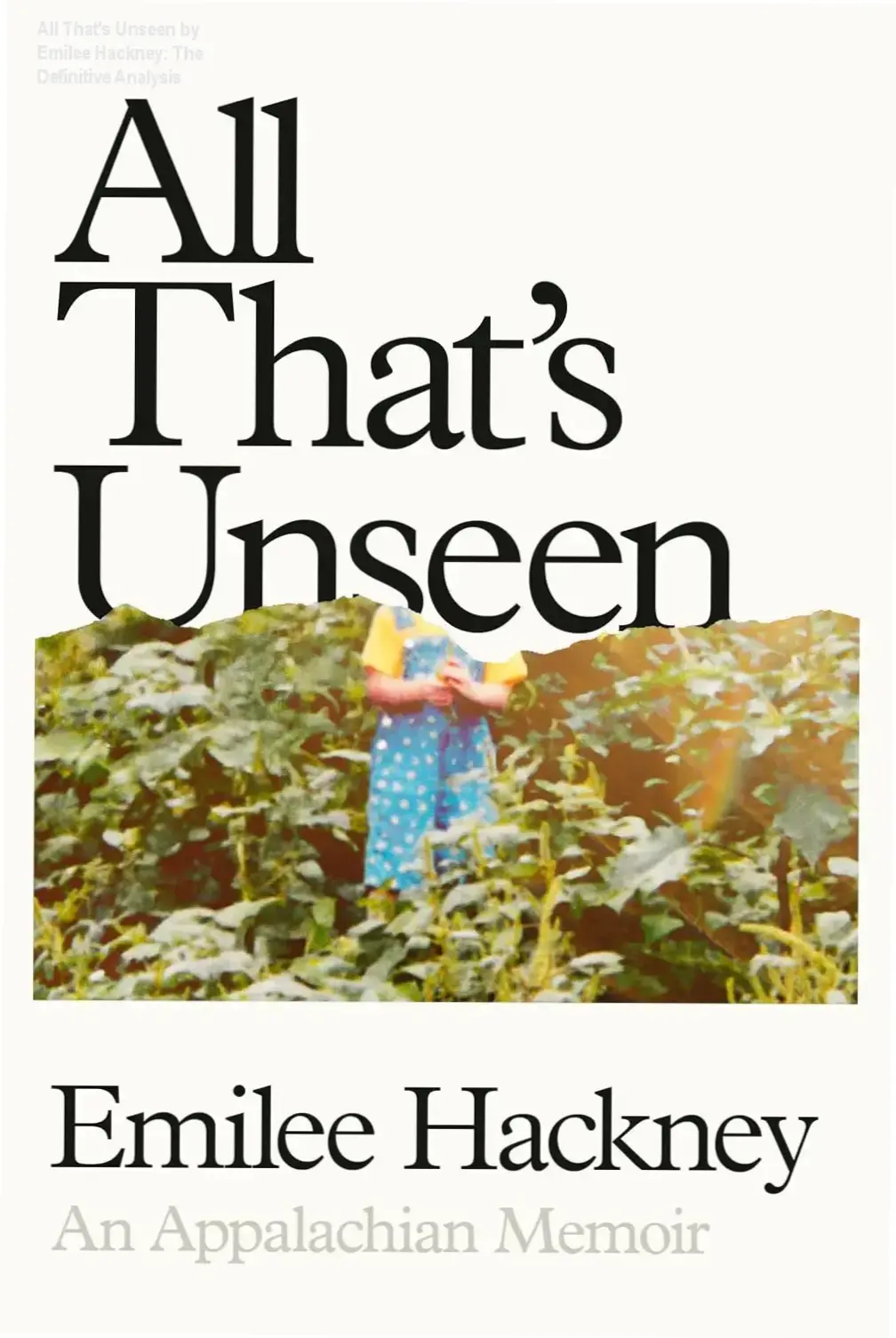
Emilee Hackney’s memoir tackles this tension head-on, exploring the violent friction between spiritual submission and intellectual awakening. It is a narrative about the courage required to dismantle a version of yourself that was built by others. If you have ever felt trapped by the expectations of your upbringing, you can check the current reader reception of All That’s Unseen to see how Hackney’s journey resonates with others who have fought for their own autonomy.
Ready to dive into “All That’s Unseen”?
Explore available editions, check current live pricing, or download a free sample directly on Amazon.
*You will be redirected to Amazon. As an Amazon Associate, we may earn from qualifying purchases.
The Appalachian Paradox: Beauty vs. Brutality
Hackney doesn’t fall into the trap of romanticizing poverty or painting Appalachia as a monolith of misery. Instead, she presents a paradox. The mountains are luminous and magisterial, but the economic reality—the “brutal grip” of the coal mines—is a predatory force.
As an eighth-generation resident of southwest Virginia, Hackney understands that the land is both a sanctuary and a prison. The narrative establishes a strong sense of place that feels almost like another character in the book.
The prose captures the weight of ancestral memory. She describes the coalfields not just as a workplace, but as a cycle of dependency and hardship that shapes the psychology of everyone in the holler.
“A story of losing her faith, finding her way back to her Appalachian home, and discovering what endures.”
This duality is where the book finds its strength. It acknowledges the love for home while being brutally honest about the systemic traps that keep people from leaving.
Spiritual Entrapment and the Pentecostal Noose
The core of the conflict arrives with the introduction of Sam and the Deliverance Christian Church. This isn’t just a story about “going to church”; it’s an analysis of spiritual abuse and the mechanics of control.
Hackney details the radical shift into Pentecostalism, where submission is framed as the ultimate virtue. For a fourteen-year-old, the promise of a structured, divine path is seductive.
The book examines how extremist doctrines isolate individuals. By the time she is engaged at nineteen, the “submission to God” has effectively become a submission to a man who is not who he claims to be.
Reader discussions on Goodreads often highlight this section as the most harrowing. The psychological toll of being taught that your own intuition is a sign of “sin” or “disobedience” is portrayed with clinical precision.
Hackney doesn’t shy away from the shame. She explores how spiritual entrapment creates a mental fog that makes the exit door invisible, even when it’s standing wide open.
The Great Intellectual Leap: Tazewell to Cambridge
The pivot point of the memoir is one of the most satisfying narrative arcs in recent non-fiction. The transition from the isolation of Virginia to the hallowed halls of Harvard is a jarring, necessary contrast.
This isn’t a typical “rags to riches” story. It is an intellectual rescue mission. Applying to Harvard wasn’t just about education; it was an act of defiance against a system that told her she was nothing without a husband and a church.
The contrast in environments serves as a mirror. In Cambridge, she is forced to reconcile her Appalachian identity with her new academic reality. The “imposter syndrome” here is not just personal, but cultural.
She skillfully uses the backdrop of the 2016 election to highlight the widening chasm between her home and the world she entered. It adds a layer of sociopolitical urgency to her personal journey.
Who Should Actually Read This?
This isn’t a generic “overcoming adversity” story. All That’s Unseen is specifically engineered for readers who gravitate toward the intersection of sociology, faith, and trauma.
It is a high-value read if you are interested in:
Religious Deconstruction: Specifically the psychological mechanics of Pentecostalism and spiritual submission.
Regional Identity: An authentic, non-caricatured look at Appalachian culture beyond the stereotypes.
Academic Ascent: The jarring contrast between extreme isolation and the intellectual rigor of Harvard.
Who Should Skip It
Avoid this book if you are looking for a “how-to” manual on escaping religious cults. This is a narrative memoir, not a self-help guide. If you prefer fast-paced plots over internal emotional reckoning, the pacing may feel too slow.
Additionally, readers expecting a purely political critique of the 2016 election will be disappointed. While the election serves as a backdrop, the core of the book is an intimate, psychological journey, not a political manifesto.
Value for Money: The Analysis
At 384 pages, the book offers a substantial deep dive. You aren’t paying for “fluff” or repetitive anecdotes. Hackney’s writing is precise and intellectual, making the hardcover a worthy investment for those who appreciate literary quality over quick consumption.
The real value lies in the “intellectual bridge” she builds. She manages to validate her origins while ruthlessly analyzing the systems that almost broke her. It’s a rare balance of empathy and skepticism.
Common Misconceptions
Is it an anti-religion book? Not exactly. It’s an anti-entrapment book. It focuses on the abuse of power and the loss of self, rather than a theological debate on the existence of God.
Is it a “rags to riches” story? No. The transition to Harvard isn’t presented as a victory lap, but as another arduous process of reinvention and alienation.
For those wanting to gauge the community’s reaction to Hackney’s transparency, it’s worth checking the latest reader reviews and ratings to see if her perspective aligns with your current reading goals.
Final Editorial Verdict
“All That’s Unseen: An Appalachian Memoir” delivers on its core promise for its intended audience, offering compelling insights without fluff. As highlighted in our detailed edition breakdown, its practical depth and readability are its greatest strengths.
Breaking away from a closed community isn’t just about moving to a different zip code. It is a violent psychological detachment from everything you were taught to believe about God, family, and your own worth. For many, the Appalachian experience is reduced to a caricature of poverty and coal. However, Emilee Hackney’s narrative shifts the…
Imagine waking up one day to find your meticulously curated life—complete with a viral Instagram feed, a supportive husband, and a thriving “traditional” family—suddenly replaced by a 19th-century farmstead, complete with outhouses and firewood. This is the disorienting premise of *Yesteryear: A GMA Book Club Pick: A Novel* by Caro Claire Burke, a satirical thriller…
The billionaire boss trope is a staple of romance publishing for a reason: it packages power dynamics and wish fulfillment into a neat, escapist bundle. But the market is flooded with carbon copies where the “ruthless” hero is just a jerk with a black card and the heroine’s agency evaporates the moment he enters the…
We need to produce the first part of a professional analytical book review for the book “The Complete America’s Test Kitchen TV Show Cookbook 2001–2026: Every recipe and Product Rating from the Most-Watched Cooking Show on Public TV” by America’s Test Kitchen (author). Must be in English only. Must follow strict formatting. We need: 1….
The modern reader’s appetite for “Romantasy” has evolved beyond simple magic and kissing. We are now in an era of high-stakes political intrigue where the romantic tension is often as grueling as the actual war. The challenge for any author in this saturated market is avoiding the “middle-book slump,” where plot armor becomes too thick…
Most people imagine immigration as a suitcase and a plane ticket. In reality, it is a violent fragmentation of identity. For a child, the trauma isn’t just the war they flee, but the sudden realization that they are now “the other” in a place that looks like a movie set but feels like a cage….