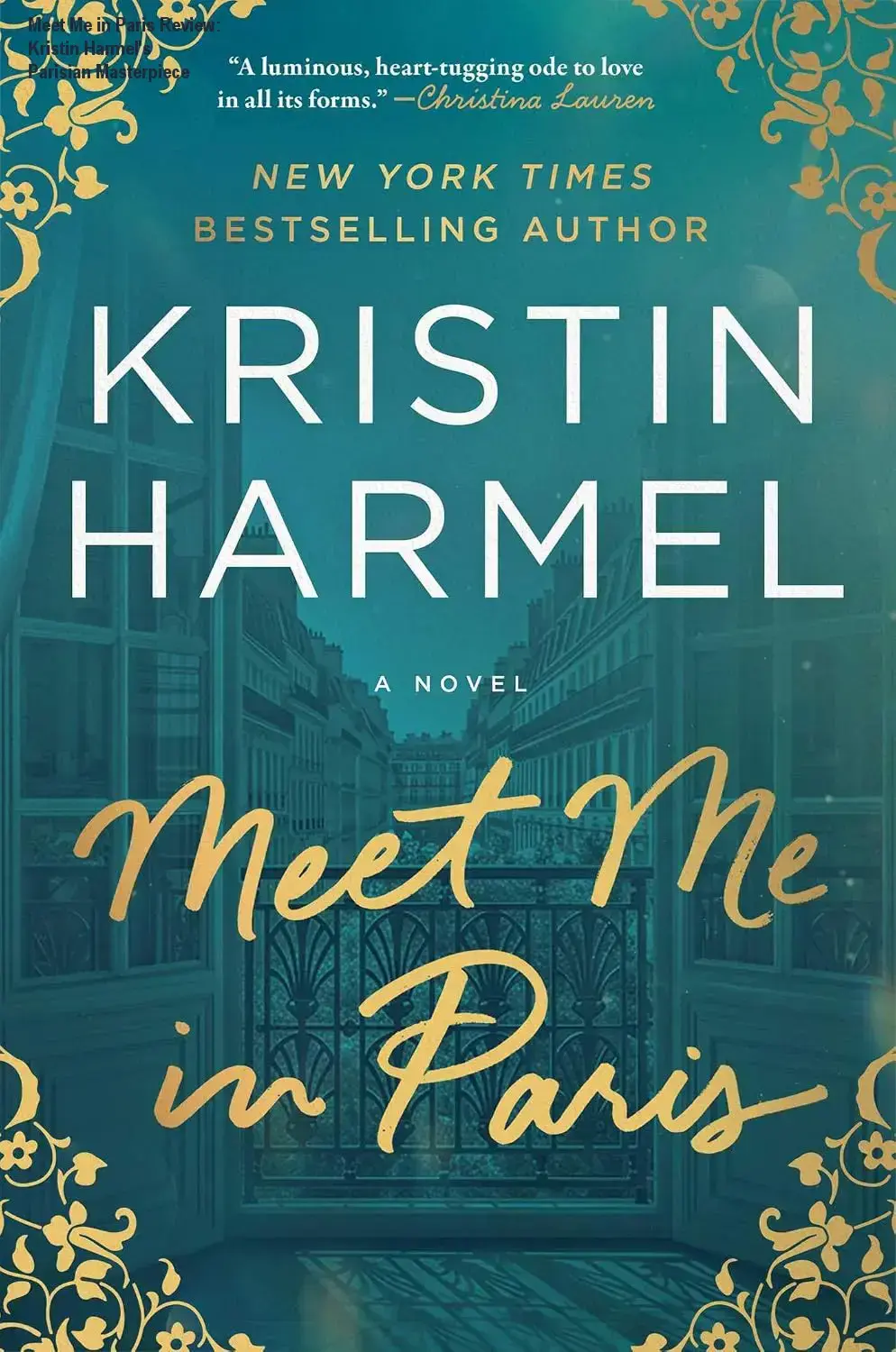
Meet Me in Paris Review: Kristin Harmel’s Parisian Masterpiece
Kristin Harmel has built a career on finding the quiet, human pulse inside historical cataclysms, but Meet Me in Paris pivots sharply toward the contemporary. It trades occupied France for a modern spring week in the City of Light, swapping wartime resistance for the quieter, messier resistance of facing mortality, infidelity, and faded relevance. The structural ambition here is obvious: nine Americans, seven love stories, one interconnected narrative web. It reads like Love Actually directed by a novelist obsessed with generational echoes. You can check the current edition details and reader reception right here.
The risk with ensemble casts this large is dilution. Three hundred sixty-eight pages split across seven distinct arcs leaves roughly fifty pages per storyline once you account for connective tissue. That is tight. Readers expecting the deep historical immersion of The Book of Lost Names might find the contemporary setting initially jarring. The central hook—Julia Glover’s terminal diagnosis framing a final mother-daughter trip—provides the emotional anchor, but the surrounding orbits (a rock star’s comeback, a songwriter’s eighty-year secret, a grandmother confronting dementia) fight for oxygen. Harmel’s prose remains accessible, almost aggressively readable, but the question remains: does breadth come at the cost of depth?
Ready to dive into “Meet Me in Paris”?
Explore available editions, check current live pricing, or download a free sample directly on Amazon.
Preview Free Sample & Check Price on Amazon
*You will be redirected to Amazon. As an Amazon Associate, we may earn from qualifying purchases.
Writing Style, Pacing, and the “Harmel Voice”
Harmel writes with a distinct cadence. Short sentences. Clipped dialogue. A focus on sensory details—rain on cobblestones, the smell of espresso, the texture of a worn guitar strap—that grounds even the most melodramatic beats. In Meet Me in Paris, this style serves the multi-POV structure well. It creates a rhythmic uniformity. You always know you are reading a Harmel novel, regardless of whether you are inside the head of a dying mother or a cynical rock star.
The pacing is relentless. The “one week” timeline acts as a ticking clock. Chapters are short, often ending on mini-cliffhangers or emotional reveals that propel you to the next perspective. It is engineered for the “just one more chapter” impulse. However, this speed has a cost. Internal monologues are often truncated in favor of action and dialogue. We are told characters feel things—grief, regret, sudden lust—more often than we are shown the messy, non-linear reality of those feelings.
Goodreads discussions frequently highlight this “page-turner” quality. Many reviewers admit finishing it in a single sitting. A verified Amazon purchaser noted, “It’s the literary equivalent of a Netflix limited series—bingeable, emotional, but you might not remember the specific plot points of the side characters a month later.” That assessment feels accurate. The prose is transparent; it gets out of the story’s way. But transparency can feel like invisibility when the emotional stakes demand linguistic specificity.
Dialogue is a mixed bag. The banter between Piper and her French waiter, Sylvain, crackles with the right amount of friction and charm. Conversely, the philosophical musings of Henry McGee, the nonagenarian songwriter, occasionally veer into speechifying. Real ninety-year-olds rarely articulate their trauma in perfectly structured thematic paragraphs. It breaks immersion when a character sounds like the author’s outline.
Narrative Architecture: The Ensemble Gamble
Structurally, this is a hyperlink novel. The connections range from organic (Henry is Melody’s grandfather; Jackson recorded Henry’s song) to convenient (characters repeatedly bumping into each other in a city of two million people). The “Small World” problem is the genre’s oldest trap. Harmel mostly navigates it by leaning into the theme: Paris is a village for a certain class of American visitor. The setting does the heavy lifting of plausibility.
The seven love stories map onto distinct archetypes:
- End-of-Life Love: Julia and the stranger at the dive bar. High stakes, limited time.
- First Love / Coming of Age: Piper and Sylvain. Bright, sensual, low stakes but high emotional resonance for the daughter.
- Redemption / Late-Life Revelation: Henry and Celeste. The historical anchor. The strongest thread.
- Marriage Crisis: Melody and Gilles. The most grounded, relatable, and arguably under-explored arc.
- Self-Love / Identity: Jackson Quick. The rock star shedding his skin.
- Platonic/Familial: The mother-daughter core (Julia/Piper).
- Secondary Romance: A few minor pairings that fill the margins.
The Henry/Celeste storyline is the novel’s spine. It carries the historical weight Harmel’s readership expects. The dementia portrayal is handled with a surprising lack of sentimentality. The idea that music bypasses cognitive decay to reach emotional memory is well-trodden neuroscience, but Harmel executes the specific mechanics—Henry singing specific lyrics to trigger specific memories—with genuine tenderness. This thread alone justifies the hardcover price for many readers.
Conversely, the Melody/Gilles infidelity plot feels rushed. Twenty years of marriage, a cosmetic empire, a Parisian lifestyle—all compressed into a few confrontational scenes. The resolution (or lack thereof) feels like a plot point checked off a list rather than a lived experience. Several Reddit threads in r/historicalfiction and r/books criticized this specific arc for “chick-lit tropes” that clashed with the literary fiction aspirations of the Henry storyline.
| Storyline | Core Conflict | Payoff Satisfaction |
|---|---|---|
| Henry & Celeste | 80-year separation, dementia, WWII trauma | High (Emotional core) |