
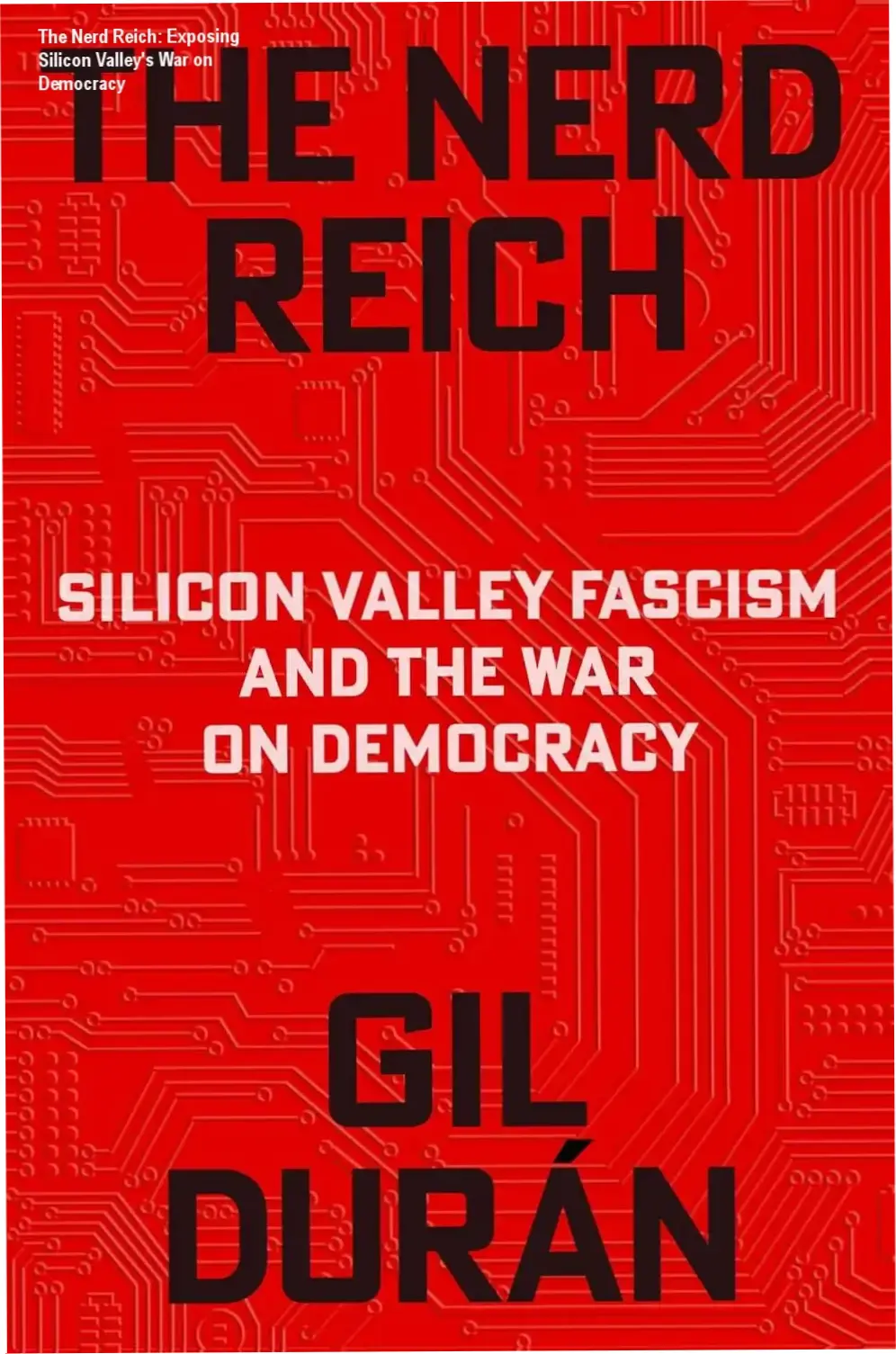
The Nerd Reich: Exposing Silicon Valley’s War on Democracy
We often treat technological disruption as a force of nature—inevitable, messy, but ultimately progressive. Gil Durán’s The Nerd Reich shatters that comfort. It argues the chaos isn’t a bug; it’s the feature. The book maps a deliberate, decades-long ideological project to swap democratic accountability for corporate sovereignty, tracing a direct line from obscure libertarian texts to the inner circles of the current US administration. Durán writes with the urgency of a political operative who has seen the machine from the inside because he has. If you want to understand why the richest men on earth are suddenly obsessed with “network states” and “exit,” this investigation is the essential primer.
The timing is brutal. Published just as the rhetoric of “efficiency” and “deconstruction” moves from podcasts to executive orders, the book feels less like history and more like a real-time threat assessment. Durán doesn’t just profile billionaires; he dissects the philosophical scaffolding—specifically The Sovereign Individual—that turns greed into a grand theory of liberation. It is a dense, heavily cited work that reads like a thriller because the stakes are existential. The central question isn’t “will tech change society?” but “who authorized these specific unelected architects to draft the sequel to the Constitution?”
Ready to dive into “The Nerd Reich: Silicon Valley Fascism and the War on Democracy”?
Explore available editions, check current live pricing, or download a free sample directly on Amazon.
Preview Free Sample & Check Price on Amazon
*You will be redirected to Amazon. As an Amazon Associate, we may earn from qualifying purchases.
Writing Style: Investigative Urgency Meets Intellectual History
Durán does not write like a typical academic. He writes like a journalist who spent years in the trenches of San Francisco politics—because he did. The prose is sharp, devoid of the usual tech-journalism sycophancy. There are no “visionary” epithets here. Instead, you get surgical deconstructions of blog posts, leaked emails, and obscure conference speeches.
The pacing is relentless. Early chapters lay the philosophical groundwork (Davidson, Rees-Mogg, Moldbug) without drowning the reader in jargon. By the time Durán connects Curtis Yarvin’s “Dark Enlightenment” to Peter Thiel’s checkbook and eventually to the White House personnel files, the narrative velocity has shifted from history lesson to political thriller. It is a difficult trick: making intellectual genealogy feel like a crime procedural. He pulls it off by anchoring abstract theory in concrete political mechanics—zoning battles, school board recalls, judicial appointments.
Readers on Goodreads consistently highlight the “breathless” quality. One verified reviewer noted, “It reads like a spy novel, except the spies are billionaires and the target is your vote.” That friction—high-stakes political analysis delivered at airport-thriller speed—is the book’s signature. It respects the reader’s intelligence but refuses to let the complexity of the ideology obscure the simplicity of the goal: power.
Core Arguments: The Blueprint for Digital Feudalism
The book’s central thesis is that “The Network State” is not a metaphor. It is a literal governance model. Durán traces the evolution from Balaji Srinivasan’s theoretical “cloud communities” to the very real political operations in San Francisco (the recall of Chesa Boudin, the school board recalls, the moderator variables). He argues these were beta tests. The laboratory was a city; the target is the federal state.
He structures the argument in three distinct movements. First, the Philosophy: How The Sovereign Individual provided the intellectual cover for anti-democratic sentiment. Second, the Apostles: Thiel, Andreessen, Srinivasan, Musk. Durán shows how they differ in temperament but align on the core objective—exit over voice. Third, the Infrastructure: Crypto as sovereign currency, AI as the administrative state, social media as the propaganda arm.
A critical insight is the redefinition of “innovation.” Durán demonstrates that for this cohort, innovation means the removal of friction—specifically, the friction of consent. The “move fast and break things” mantra is reframed: the things being broken are democratic guardrails. The “speed” is necessary to outrun accountability. This reframing alone is worth the price of admission. It changes how you read every tech press release forever.
Key Quotes & Analytical Highlights
“Democracy is being dismantled not by coups or tanks, but by code, capital, and the illusion of innovation.”
This is the book’s thesis statement. It appears early and echoes through every chapter. Durán supports it with receipts. He details how crypto lobbying wrote its own legislation, how AI “safety” frameworks are drafted by the companies building the models, and how “charter cities” projects (like Próspera in Honduras) serve as proof-of-concept for corporate sovereignty.
“The promise of technological liberation has transformed into a global movement for digital feudalism.”
The “feudalism” charge is not rhetorical flourish. Durán maps the specific mechanics: platform owners
Who This Book Is For
Policy analysts, journalists, and technologists tracking the intersection of code and power will find this essential. It connects philosophical roots to current White House influence with precision. Readers who enjoyed The Sovereign Individual but want the critical counter-narrative are the core audience.
Who Should Skip It
Anyone expecting a neutral history of Silicon Valley. This is polemic with receipts. Readers wanting practical tech policy solutions will find diagnosis over prescription. If you believe “move fast and break things” is just a management philosophy, the thesis will feel like a category error.
Common Purchasing Missteps
Buying the audiobook expecting light commute listening. Durán’s sentence density rewards annotation. Assuming the 2026 publication date means speculative futurism — it’s investigative reporting on moves already executed. Confusing “fascism” in the title with rhetorical flourish; Durán defines the term operationally, not emotionally.
Contextual FAQ
Is it partisan? It targets a specific ideological current, not a party. Democrats funded by Thiel appear alongside Republicans.
How current is it? Publication date is August 2026. The manuscript likely closed early 2026. Events after that are absent.
Sources? Heavy on public records, leaked comms, and Durán’s own political reporting. Light on anonymous insider testimony.
Editorial Summary
The Nerd Reich succeeds as intellectual genealogy. It fails as resistance manual. The “road map” promised in the blurb is three pages of general principles. Value lies in naming the architecture: network states, corporate sovereignty, algorithmic governance. You finish understanding the blueprint. Whether that helps stop the build is the open question. For readers ready to trace the money and the memes to their logical terminus, the hardcover edition includes extensive endnotes worth the shelf space.
Final Editorial Verdict
“The Nerd Reich: Silicon Valley Fascism and the War on Democracy” delivers on its core promise for its intended audience, offering compelling insights without fluff. As highlighted in our detailed edition breakdown, its practical depth and readability are its greatest strengths.
We also recommend checking the official Kindle sample and reader ratings before making your final purchase decision.
*You will be redirected to Amazon. As an Amazon Associate, we earn from qualifying purchases.